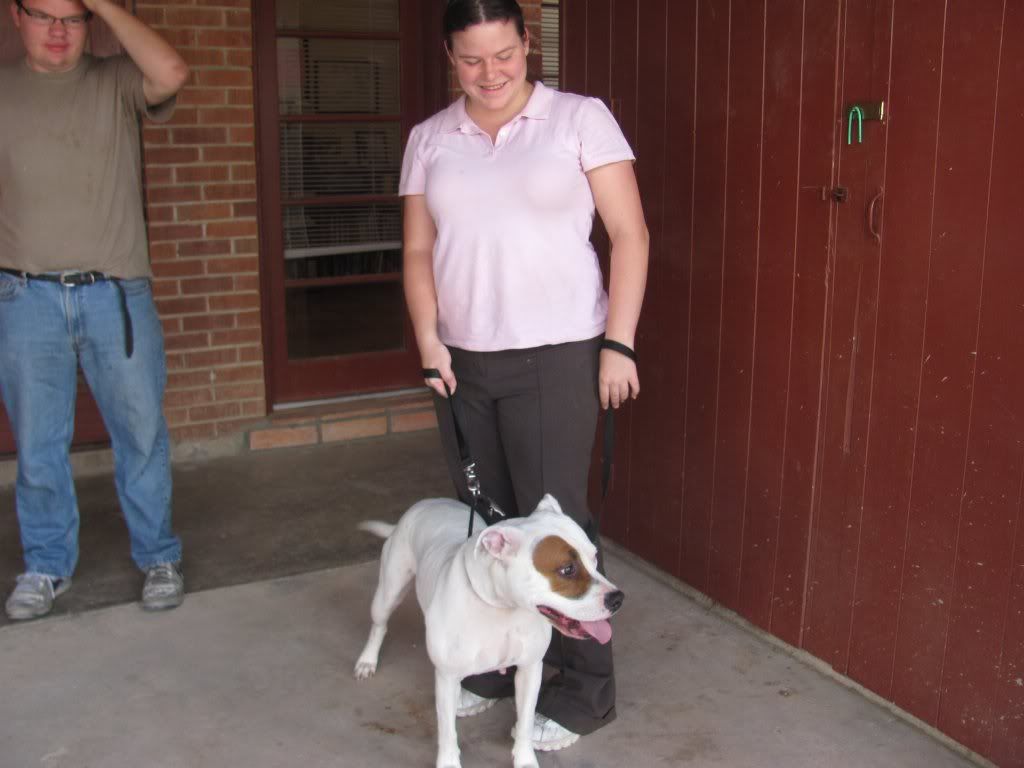
To crate or not to crate? It's a big issue in the world of dogs. There are those who swear by crates and those who abhore them as torture and there are those in between.
Today I witnessed a rant by someone who was trying to adopt a puppy from a rescue and was turned down because of his views (so he says) about crates. He is for crates, so is the rescue, but there was a HUGE difference between them in how a crate should be used.
I use crates. In the last 4 years, with the 4 puppies that I've raised as my own, I've used a crate for them all until they were 9 months to a year old. That three month difference between dogs was due to differences in maturity level between the puppies. Only one of the puppies was crated at night and when I wasn't home until a year old. The rest were free of the crate at 9 months. When I was home, they were free to roam the house after they were 4 months old.
In this last 4 years I have had no problems with potty training, chewing or other destruction, counter surfing, trash diving or any of the other normal issues people have with adolescent dogs. The oldest dog is now 4 and the youngest is 20 months. There have never been any fights between these dogs - ever. None of them have separation anxiety, fear of thunder or fireworks, they are friendly to other friendly dogs and love meeting new people. These were all puppies that I raised from 8 weeks old. I have had fosters during this time as well. The oldest is now living with my daughter and two young grand children.
So what about older dogs that are adopted? Should you use a crate? In my opinion and practice, yes. The new dog, no matter what it's age, condition or behavior issues, knows nothing about you, your other animals, your rules, boundaries and limitations. They need to learn those and earn your trust just as you need to earn their's. So a crate is essential and in the first week of having a foster I use the crate for everything. The dog sleeps in the crate, is in the crate to eat and when I'm not home or I'm working intensely on the computer and don't have any spare attention units. If the foster is ill to begin with, the time in the crate is longer to make sure the dog gets sufficient rest in order to heal.
In the almost 59 years I have lived with dogs, the adult dogs have had free run of the house and the yard. In those 59 years - 17 of which I was still living with my parents - I have lived with 23 adult dogs and numerous puppies (more then 40). Some of the adult dogs were raised from puppies, some were adopted from the pound as adults. None of them stayed in a crate with the door closed for any reason after the first year (that long only for the puppies - otherwise 30 - 45 days was the longest). The time the dogs spent in the crates, other then at night, was never more then 3 hours at a time and then an hour of exercise, training and non structured play. The time out of the crate, free to roam the house, was progressively lengthened as my trust in the dog's ability to live appropriately in my world increased.
One of the dogs that I grew up with, had it been in a crate unable to interact with the environment, would not have been able to warn my sister of the 71 earthquake in So Cal. My sis would have been severly injuried had Petunia not woken her up. A large heavy book shelf fell on her bed.
In those 59 years I have had only three fights happen. Two were mildly serious because of the size difference between the dogs, the other wasn't serious at all. All three of the fights were provoked by one of the dogs involved and the other dog defended itself. I witnessed all three fights and all three involved the same dog of mine and someone else's dog. There has never been a fight when I wasn't around - at least not any that involved blood or other evidence that there had been a fight.
Thursday, October 6, 2011
Saturday, October 1, 2011
General Training Tips
“Anything a dog can learn on his own is more effective and better understood than what humans can force on the dog.” – Randy Hare
A dog does a certain behavior because it gets him something. It doesn't really matter what that something is. If you supporess a behavior instead of figuring out what the reinforcers are and removing them, the dog will eventually find another behavior that will get him those reinforcers. Change the environment and you change the behavior. Change the behavior and it's likely to be replaced by some other behavior which could be equally as annoying or dangerous.
Probably the most common training mistake is being inconsistent. Inconsistency exists in the mechanicals and in your emotion. Emotionally, you, the trainer, become overly excited, frustrated, and/or stressed, and your dog doesn’t even know who you are anymore. Maybe your voice gets really high, loud, commanding or shrill. Maybe you start to beg, or plead with your dog to do what you're asking. When you get like this, your dog starts searching for some way to get away from you. Who can blame her?
Many people embrace the concept that there are no bad dogs, that there are only humans who aren't handling the dog correctly. Despite this, I still see too much that puts the dog in the hot seat, teaches the dog to behave, suppresses the dog's natural energy and instincts. I'd rather see people replace "training" with "playing" and teaching a dog how to be a dog and how to live in the human world. The days when trainers concentrated mainly on showing dogs, competing with their dogs, hunting or working with their dogs is largely a thing of the past. I'd say that 90% of all dogs are pets and companions. Why continue to follow a model that doesn't fit the paradigm?
When training your dog, or just with life in general, cultivate your ability to observe - to see what is actually hapening uncolored by emotion or past failure. Look for things are aren't there as well as things that are there. If you do this often enough and long enough, you will start to see patterns in your dog, in your life, in nature and in society, and you will be able to put those patterns and observation to good use.
Seeing what is happening around us, what is there and not there, is something we unconsciously do all the time. Make a decision to consciously do this. You can learn a lot about people -- and dogs -- very quickly.
"He should just do it because I have asked". I have often heard this despondent remark from the humans during class and at private training lessons. Regardless of the difficulties at that time (anxiety, confusion, fear, or lack of solid previous training). In my view, not only is this statement a little dictatorial, but it also lacks realism.
I have heard there are trainers that say they can train a dog with only this motivation "because I asked". I've never seen a mention,however, of how they will get a distracted, unfocused, could care less about the human at the other end of the leash, dog to "do as one asks".
So, when faced with this plea, I can only ask one question: ‘How’s that working out for you?’. ‘That’ being the often unsuccessful demand that the dog should simply obey - the plea for me to do it all, for the magic wand to come out of the closet.
Learn to view the leash as only an accessory required by law. The leash should be almost non-existent as far as the dog is concerned. To train a truly loose-leash walk means the leash "invisible" in its impact on the dog - the leash is not used to control where the dog is walking or how the dog responds to stimuli except in an emergency. Even in an emergency, to continue to promote the loose leash... philosophy, don't jerk or tug the leash, just turn around swiftly and run away from the danger. Your dog may reach the end of the leash a few times in practicing this and get jerked just because it's the end of the leash, but the energy, emotion and frustration from you is not there. The dog learns to stay WITH you instead of learning to "respect" the leash. You learn that your dog can make the choice to be with you and not be constantly in a battle with you.
What Happens Here at Seize The Leash
It's really interesting to watch my students as they navigate through either a group class or private behavior training. Almost every one of them takes, in about six weeks, the same journey I as a behavior trainer have taken in my exploration of training and behavior of animals and in particular - dogs.

The first session, they are all about the mechanics - how do I do this, how did you get him to do that, what are the steps and how do I do them. This first session there is usually no desire to understand the dog or the theory behind why the mechanics exist. In the second or third session - depending on whether the human is really invested in changing their dogs emotions about things, they start asking why and actually listening to the explanations.
Then around week five, the light bulbs start going off and understanding of what is happening not only with their dog but themselves starts happening. This is why I try very hard not to do marathon sessions for changing behavior like you see on TV. This is the progress that is necessary to actually get permanent behavior change. In my experience, it takes 6 to 8 weeks for the dog to change his emotions backed by the change in emotions of the dogs humans. Both changes have to occur and the human has to start understanding body language, emotions, energy and the mechanics. Mechanics alone, which is all that can be learned in a marathon one day session, does not give permanent change.
Some of the training here at Seize The Leash is based on Natural Dog Training, a branch of dog training that looks at behaviour in terms of energy. It is, in many respects, similar to Natural Horsemanship, which looks at horse behavior in terms of the dynamic relationship between predator and prey, but transposed into the dog's world. It is therefore based on the hunting behaviors of dogs - why they chase, chew and tug... things.
Natural Dog Training looks to answer two fundamental questions in a dogs life.
•What do I do with my energy?
Knowing what to do when the world around is unnatural and confusing leads to many problems that owners can struggle to deal with.
•Where is the danger?
The second question centers on fear and the need for safety.
Natural Dog Training aims to answer these questions, resulting in a happy dog that knows how to behave appropriately and make choices that reflect it's knowledge and understanding of the human world.
The Natural Dog Training philosophy holds that a dog’s social energy, which governs his desire to learn and obey, is inextricably linked to his hunting instinct. By playing games that stimulate and satisfy the emotions contained within a dog’s prey drive, we automatically restructure the emotional dynamic between owner and dog. This, in turn, creates focus from dog to owner and a strong desire for harmony between the species.
How we utilize Natural Dog Training is in creating an understanding in the human that the dog isn't out to dominate and control everything. That a dog is a social creature who's nature is to be attracted to certain environmental stimuli and social groups. We teach both the dog and the human how to related to each other, play with each other and create a bond that supercedes anything the environment can provide.
One of the first things dogs and humans learn from us is leash manners. Many problems are created by mis-handling the leash on a walk. It seems like a gut reaction for humans to always jerk the leash and yell at the dog.whenever the dog reacts/lunges/barks at another dog while on leash.
Turn your walk into a dance with your dog and most of these issues disappear. The very first lesson all group students learn is how to dance, how to create an understanding in the dog that there doesn't have to be any pressure or pain in the neck and shoulders, and the human learns how not to create that discomfort and yet still have the dog willing to walk with the human. This takes on average about 20 minutes.
During this first session, why the dog is reactive is addressed. Most fearful dogs are under a lot of stress. Stressed dogs don't respond to praise, treats, toys or much of anything. Nearly their entire focus is on looking for the danger. You must first reduce the stress in the environment before you can start any training or behavior program successfully. Teach the dog to focus on you so that you can answer the two questions most dogs have - please help me with all this energy and take care of the danger.
Those two questions are completely answered in session 2 when the humans learn how to take their dogs energy and show the dog what to do with it by use of targeting. Targeting is the most useful skill you can teach your dog. It helps them build focus, confidence and self control, it shows the dog that you can control the environment all around him so he doesn't have to, it teaches him to work near you or away from you and that it can be fun to work away from you and it allows you a method of redirecting the dog away from reactivity or danger.
Too many humans have required that dogs conform to a different set of rules – rules that come from the human world, not the animal world. This attitude of human only adds a stressful dimension to a dog's existence that can eventually move them from calm intent, to frustration and eventually into aggression. This attitude gives humans an excuse not to "listen" to their dogs, so as communication after communication goes unnoticed or unrecognised, dogs become behavior problems.
Structure, more then leadership, is what helps dogs relax and understand the human world. Structure, like leadership, involves consistency and predictable consequences. Dogs do not need or want to be completely “free” and unstructured. Most dogs value structure over pure freedom. Structure handles anxiety and fear of the unknown and the future. A shelter dog put into a new home situation and left to his own devices can suffer a mild meltdown. Shelter dogs are not in shelters because of too much structure--they are often there because they never received enough. For children and pets, proper structure is a gift of love.
Week 3 is all about structure, confidence and movement. Our world, the human world tends mostly to be flat, but at best is mostly right angles with long stretches of flat. Our dogs need spaces to move where they have pot holes to avoid, branches to jump, trees to dodge around, different surfaces, textures, smells and interesting things to chase. With the use of TTouch, The Playground For Higher Learning, Massage, scent games and agility equipment, we show you how to create a world that is closer to what is natural for a dog.
The Natural Dog Training philosophy holds that a dog’s social energy, which governs his desire to learn and obey, is inextricably linked to his hunting instinct. By playing games that stimulate and satisfy the emotions contained within a dog’s prey drive, we automatically restructure the emotional dynamic between owner and dog. This, in turn, creates focus from dog to owner and a strong desire for harmony between the species.
The best way to train a dog is to do it while its prey drive has been activated. Work on obedience and other behaviors during a game of tug-o-war or fetch tug, and use the games themselves as the reward for compliance. Feed your scent hound its meal by sprinkling it on the lawn and practice behavior cues during the hunt. Teach recall by running away from the dog or moving away or making a noise resembling a prey animal. Find out what your dog really likes to put its heart into and train while it’s driven and can win by obeying.
With Seize the Leash, the prey drive, the need to chase, catch, shake, bite and most of those things we humans seem to need to control, are addressed in weeks 4, 5 and 6. With the use of games, the flirt pole, learning how to play tug and retrieve so as to redirect and control your dogs need for the hunt, both the dog and the human learn that a dog can still be a dog in a human world without stress.
"We’ve been taught to believe that a dog’s wild essence needs to be tamed, and by taming it he will become the perfect companion. But it is this very wildness that makes the dog social and allows him the ability to live with us in the first place. It’s this essence that needs to be nurtured and loved, not trampled and suppressed. The irony of course is that most dog owners will tell you that they love dogs, when the truth of the matter is that they actually live in fear of them. And dogs being our mirrors, what does that tell you about who they really fear?" Sang Koh
After six weeks of learning how your dog thinks, what it responds to instinctively and individually, how to get and hold your dog's attention and then direct that attention to safe and fun channels, build his confidence and yours and how to play again, you'll have a different dog and the dog will have a new life.
The first session, they are all about the mechanics - how do I do this, how did you get him to do that, what are the steps and how do I do them. This first session there is usually no desire to understand the dog or the theory behind why the mechanics exist. In the second or third session - depending on whether the human is really invested in changing their dogs emotions about things, they start asking why and actually listening to the explanations.
Then around week five, the light bulbs start going off and understanding of what is happening not only with their dog but themselves starts happening. This is why I try very hard not to do marathon sessions for changing behavior like you see on TV. This is the progress that is necessary to actually get permanent behavior change. In my experience, it takes 6 to 8 weeks for the dog to change his emotions backed by the change in emotions of the dogs humans. Both changes have to occur and the human has to start understanding body language, emotions, energy and the mechanics. Mechanics alone, which is all that can be learned in a marathon one day session, does not give permanent change.
Natural Dog Training looks to answer two fundamental questions in a dogs life.
•What do I do with my energy?
Knowing what to do when the world around is unnatural and confusing leads to many problems that owners can struggle to deal with.
•Where is the danger?
The second question centers on fear and the need for safety.
Natural Dog Training aims to answer these questions, resulting in a happy dog that knows how to behave appropriately and make choices that reflect it's knowledge and understanding of the human world.
How we utilize Natural Dog Training is in creating an understanding in the human that the dog isn't out to dominate and control everything. That a dog is a social creature who's nature is to be attracted to certain environmental stimuli and social groups. We teach both the dog and the human how to related to each other, play with each other and create a bond that supercedes anything the environment can provide.
Turn your walk into a dance with your dog and most of these issues disappear. The very first lesson all group students learn is how to dance, how to create an understanding in the dog that there doesn't have to be any pressure or pain in the neck and shoulders, and the human learns how not to create that discomfort and yet still have the dog willing to walk with the human. This takes on average about 20 minutes.
During this first session, why the dog is reactive is addressed. Most fearful dogs are under a lot of stress. Stressed dogs don't respond to praise, treats, toys or much of anything. Nearly their entire focus is on looking for the danger. You must first reduce the stress in the environment before you can start any training or behavior program successfully. Teach the dog to focus on you so that you can answer the two questions most dogs have - please help me with all this energy and take care of the danger.
Those two questions are completely answered in session 2 when the humans learn how to take their dogs energy and show the dog what to do with it by use of targeting. Targeting is the most useful skill you can teach your dog. It helps them build focus, confidence and self control, it shows the dog that you can control the environment all around him so he doesn't have to, it teaches him to work near you or away from you and that it can be fun to work away from you and it allows you a method of redirecting the dog away from reactivity or danger.
Too many humans have required that dogs conform to a different set of rules – rules that come from the human world, not the animal world. This attitude of human only adds a stressful dimension to a dog's existence that can eventually move them from calm intent, to frustration and eventually into aggression. This attitude gives humans an excuse not to "listen" to their dogs, so as communication after communication goes unnoticed or unrecognised, dogs become behavior problems.
Structure, more then leadership, is what helps dogs relax and understand the human world. Structure, like leadership, involves consistency and predictable consequences. Dogs do not need or want to be completely “free” and unstructured. Most dogs value structure over pure freedom. Structure handles anxiety and fear of the unknown and the future. A shelter dog put into a new home situation and left to his own devices can suffer a mild meltdown. Shelter dogs are not in shelters because of too much structure--they are often there because they never received enough. For children and pets, proper structure is a gift of love.
Week 3 is all about structure, confidence and movement. Our world, the human world tends mostly to be flat, but at best is mostly right angles with long stretches of flat. Our dogs need spaces to move where they have pot holes to avoid, branches to jump, trees to dodge around, different surfaces, textures, smells and interesting things to chase. With the use of TTouch, The Playground For Higher Learning, Massage, scent games and agility equipment, we show you how to create a world that is closer to what is natural for a dog.
The Natural Dog Training philosophy holds that a dog’s social energy, which governs his desire to learn and obey, is inextricably linked to his hunting instinct. By playing games that stimulate and satisfy the emotions contained within a dog’s prey drive, we automatically restructure the emotional dynamic between owner and dog. This, in turn, creates focus from dog to owner and a strong desire for harmony between the species.
The best way to train a dog is to do it while its prey drive has been activated. Work on obedience and other behaviors during a game of tug-o-war or fetch tug, and use the games themselves as the reward for compliance. Feed your scent hound its meal by sprinkling it on the lawn and practice behavior cues during the hunt. Teach recall by running away from the dog or moving away or making a noise resembling a prey animal. Find out what your dog really likes to put its heart into and train while it’s driven and can win by obeying.
With Seize the Leash, the prey drive, the need to chase, catch, shake, bite and most of those things we humans seem to need to control, are addressed in weeks 4, 5 and 6. With the use of games, the flirt pole, learning how to play tug and retrieve so as to redirect and control your dogs need for the hunt, both the dog and the human learn that a dog can still be a dog in a human world without stress.
"We’ve been taught to believe that a dog’s wild essence needs to be tamed, and by taming it he will become the perfect companion. But it is this very wildness that makes the dog social and allows him the ability to live with us in the first place. It’s this essence that needs to be nurtured and loved, not trampled and suppressed. The irony of course is that most dog owners will tell you that they love dogs, when the truth of the matter is that they actually live in fear of them. And dogs being our mirrors, what does that tell you about who they really fear?" Sang Koh
After six weeks of learning how your dog thinks, what it responds to instinctively and individually, how to get and hold your dog's attention and then direct that attention to safe and fun channels, build his confidence and yours and how to play again, you'll have a different dog and the dog will have a new life.
Monday, September 19, 2011
Maggie
Thank you Leetah & Lloyd for sharing your story! Your commitment to Maggie is an inspiration to everyone. And thank you to all Pit n' Proud supporters for making this story possible -- hopefully one of many more to come!
"Hello, our names are Leetah and Lloyd and we own a beautiful female American Pit Bull Terrier named Maggie. She is 3-years-old as of right now.
We got Maggie when she was 5-months-old from a friend. She was a hyper, lovable puppy who got along with everything. She didn't know the word stranger and she didn't know that the world wasn't all rainbows and happiness.
When she was around 9-months-old we got her a friend who was a little younger than her but around the same size. We asked his owner if he had any special needs and she told us no. We found out a little while later he had food aggression and attacked our baby girl. This was the first time Maggie learned that not all dogs were friendly. She did not kill him and he wasn't hurt to badly so we called the woman back and told her that she needed to get him to a vet and the next time she tried to give him away to tell the new owners of his food aggression.
She was attacked by 3 more dogs and that was when everything changed. She became fear aggressive around dogs (except Chihuahuas) and we will admit that we did not help by not taking her out and resocializing her. It grew to the point that she was afraid of noises and would bark and growl at anything.
These were not her only problems. She would pull constantly while walking and after a year or two my wrist was really feeling this and so I stopped walking her because it hurt to much. Once our neighbor moved away Maggie also had no more children to socialize with and so she never truly understood the difference between rough and gentle play or the different things that children will do and how to react to them.
Since we didn't go out much and we did not know how to handle our reactive dog we became reclusive and she became more of a burden then a beloved pet and family member. Once we came to Tucson it got harder since we couldn't afford her to have her own yard like in Oklahoma, which took care of her need to run and jump, and we had children all over the place making noises and running by like crazy. We were not only afraid for them but we were also afraid for the quality of living for our dog.
While looking for a safe place to relinquish our dog we came across Pit n' Proud and was told that they could help us put Maggie in behavior modification classes that would handle the fear and would teach all of us to be more confident. We were ecstatic and accepted.
The first Wednesday we will admit we were skeptical since we didn't believe that Maggie would be able to get over the fear or that we would either. Boy were we proven wrong!
Seize the Leash is where we went, and after almost being late because we stink at directions, we were welcomed and our eyes opened. Maggie is a new dog because of Pit n' Proud and Seize the Leash. She is so much calmer and confident. The barking has dropped by 95%, she doesn't lunge at dogs anymore, and the children where we live have all met and become friends with Maggie. The leash pulling we are still working on but now my wrist doesn't hurt since we learned how to hold the leash and she isn't dragging me but instead just applying some pressure telling us to walk faster. Still gotta find that medium speed we can all agree on.
Maggie is like a new dog! You can see the shine of life and wonder back in her brown eyes and she is excited about everything. We go to parks now, we take walks, we enjoy life again with our beloved family member. Thank you Rachel, Jamie and Deena for giving us the gifts you have!"
7/13/11 Maggie was in a funk today, didn't want to do much at training today. But like a good girl that likes to learn she did wonderful in the Crate Game and handled the arrival of a new dog wonderfully. Woot for progress!
Targeting is getting better with Maggie. She now touches the hand that doesn't hold the treat in varying degrees from pushing with her nose to barely touching with the nose or tongue. YAY!
7/19/11 Been working with Maggie on the Touch Game. Today we made awesome progress! I wasn't thinking clearly and told Maggie to touch my palm but didn't realize she was across the room on her bed. I was surprised when she got up and pushed her nose into my palm. My goal is to get her ready for the Touch Stick and this was a big step forwards.
7/22/11 Took Maggie to chase the lizards today. Tried some recall...yah, those lizards were very persuasive about not listening. She listened a few times, especially if she went to far out. I would tell her "Maggie, C'mere" and she would come back within the vicinity and then once again patrol for the little critters. (No lizards were harmed in the making of this post)
7/23/11 I am so glad for the Out command. Maggie got happy and hyper and she slid something across the floor. When it made noise she grabbed it started snacking but I had no idea what it was. Worried about what she was eating I rushed over there and said "Maggie Out" and she immediately sat it down and looked at me. It was just her bone but I am glad to know if it was something dangerous she would spit it out on command.
7/24/11 Maggie has a playdate! Her first playdate! I'm so excited!!
7/30/11 Took Maggie to Reid Park where we had the funniest mishap. She was thirsty and tried to take a drink from the duck pond and, misjudging the distance from ground to water, went head first into the water. At first we flipped out but after a few seconds all 3 of us realized she could touch the bottom and she just looked pitiful in the water. After getting soaked from pulling her out we went and watched ducks on a bench.
8/9/11 Maggie is learning to sit and wait for me to give her a signal before going outside and eating her food. Woot!
8/14/11WOOHOO! Fed Maggie and all I had to do was stand there with the cup of food and she sat and waited for me to move back and give her the go ahead before she ate it. YAH! *Does victory dance*
8/21/11 Maggie is doing amazing with the command Wait. She sits and waits for us to tell her to eat and I have been able to go fully outside and look away for a few seconds before letting her come outside. WOOHOO!! She's my booger, and she is making progress on her training. I know one thing she really needs: more outside play time. We need to get her into agility or just find a private place to throw random things for her to chase.
8/25/11 Maggie can stya put and wait for 5-6 seconds including when she is hyper and really wants something. As a treat for waiting so long when hyper we played catch which she is doing great at. And my aim is improving, now I just miss her mouth instead of throwing it down her throat lol
9/2/11 For fun I have been teaching Maggie to show her belly on cue and after I read this I stopped being excited and such and calmly said "Show me you belly" with the hand cue and she did it. So I tried to do it very calmly and smoothly just the cue. She did it five times in a row before she snorted at me and laid down. Can't wait to see how she responds to softer cues tomorrow during the walk!!
9/13/11 Maggie was amazing tonight. Took her to a friend's place, they have a pit bull type dog as well. He is the gentlest dog in the world and Maggie has only been outside with him there once before. They were five feet apart and she didn't bark, growl, lunge or anything bad. They whined at each other, wagged their tails, and she did a pitter patter dance. After that she ignored him and just enjoyed the night. It was amazing!!! I have a feeling they are going to be good friends.
9/14/11 Took Maggie back to the friend's house. This time Maggie and Rocky sat only a few feet away from each other. Rocky of course wanted to sniff Maggie but i am not ready for that yet. We are going to let them do some butt sniffing this weekend, the way Jamie showed us how to do with Roxie from class. I am so proud of Maggie. She also saw her first camp fire and she was such a good girl, enjoyed it and a stick.
9/17/11 SUCCESS!!!! Maggie has made a friend with Rocky!! She met him, got a butt sniff in, sniffed his face, and then she wanted to play! She even rolled onto her back for him to play. I am thinking it helps she is in heat so she wants contact with a dog (no babies though, luckily she isn't that interested in that...just lots of play and jumping). We are going to go out today and hope for the same response. THANK YOU SO MUCH!!!
9/18/11 Went back to see Rocky, he wasn't on his leash and he came pitter pattering up to Maggie and she was so happy to see him they started playing. They rolled around, jumped around and it was so cute when Maggie laid down and he put his paw on her head. She lay there and wagged her tail. They both had a blast, dirt and dust was going everywhere. Can't wait for tomorrow!!
First CLASS graduates
We have our first Canine Life and Social Skills Bachelor level graduates :)
Meet Ethel and Lucy, both goldendoodles who will be continuing their journey with the Master's level a then onto Therapy dog training and agility.
Meet Buddy, a mastiff/boxer mix who came to us through Pit n Proud. Buddy is going to take a hiatus from training (actually his humans are as they are both going through a Master's program in education), but will be back for Rally Obedience and possibly Agility.
All three dogs also passed their Canine Good Citizen test !!
Sunday, September 18, 2011
Charlie Testimonial
"I generally enjoy owning 2 dogs and lost my female lab mix in June of 2010. As much as I wanted another dog, my old male mixed breed had an aggressive disposition to most dogs, especially when they came onto our property. I enrolled Charlie in Jamie's reactive dog class for socialization and to learn dog language, cues and behaviors. Jaime trained me to support Charlie in his behavior change. I'...ve adopted a 1-2 yr old Terrier mix 5 wks ago. Jamie came to my home to observe and spend time watching the dogs. She recommended a gradual blend of the dogs in positive situations to build an early relationship. We have transitioned over the weeks to a coexistance that I thought impossible. At this point, I still observe them and they argue a bit, but they spend a fair amount of time together off leash and are overall establishing a relationship. Jamie gave me confidence to work with my dog who I thought would never allow another dog in our house. I am thrilled! "
I looked everywhere for a picture of Charlie and couldn't find one on this computer, but the picture above is the class he was in.
Friday, September 16, 2011
Zoe
Zoe is an 11 year old mix of some sort. She was fear aggressive and was not getting along with one of the other 3 dogs in her home. Zoe came to her eval and even tried to attack Brynda. She has since played in my yard with all three of my dogs successfully and is learning to work around other reactive dogs and even interact with them. There have been fewer and fewer altercations at home during this 6 weeks also.
Here is Zoe and Velvet at class learning to work together on Sept 3
And her is Zoe working the confidence course for the first time all the way through. She has done pieces of it over the 6 weeks she's been coming to different classes, but tonight she did the entire course and had a lot of fun.
Here is Zoe and Velvet at class learning to work together on Sept 3
And her is Zoe working the confidence course for the first time all the way through. She has done pieces of it over the 6 weeks she's been coming to different classes, but tonight she did the entire course and had a lot of fun.
Huey the bulldog
"We brought Huey to class completely dog aggressive. He couldn't walk past of go near a dog without going nuts ! After this 6 week course he is a completely different dog. He actually WANTS to go up to dogs now and sniff. He listens to us so much better ! I am so happy we brought him to Seize the Leash. He is so much more focused !! Thank you so much !!"
Thursday, August 18, 2011
Leadership and the e-collar
Along with the previous article about the dream I had, I woke up this morning, not with the remembrance of a dream, but a realization and sort of epiphany about true leadership, training methods and what constitutues real training and behavior modicafication.
I feel that due to advertising and the availability of e-collars at major pet store chains, the e-collar is becoming the answer to all canine issues - and not necessarily just issues of aggression, but also in actually training your dog to sit, down, heel, come and stay.The e-collar is becoming the first tool used instead of the last result for many trainers.
How do I feel about e-collars? I feel they have their uses, in handling aggression when all other methods have been exhausted, or the finances of the owner have been exhausted, and the only other recourse is to euthanize the dog. In other words, to save a dogs life.
While in theory I can say I would only use shock as a last ditch effort to save the dog’s life when no other method has worked, I have only had to do this once and there were only three "shocks" involved. More often than not these cases involve an owner who mistakenly believes that shocking the dog is an easy magic bullet solution . More often then not, the owner gives up because it's too much work.
If you have a toothache and take strong enough drugs the pain will go away. Cure? Marketing. Nothing but marketing. The modern human wants everything right now, without effort, with guaranteed results and preferably cheap. Fast food, weight loss, dog training. The modern human does not want the inconvenience of changing habits and lifestyles (even if temporary), does not want the inconvenience of investing time into weeks of training, the inconvenience of understanding basic dog behavior and basic learning theory. Smart marketing sells people what they want. It is primarily about selling.
In my experience, those trainers who actually use e-collars are also the ones holding on for dear life to dominance theory and the pack way of canine life. Many of the positive reinforcement trainers have moved away from the pack and dominance heirarchy theories as science advances and more is known about the true state of canine social interaction. The correction and positive punishment based trainers, as a rule, have not.
My realization this morning revolved around this, to me, dichotomy. To have true leadership, to really be a pack leader doesn't require positive punishment, it doesn't require the use of punitive tools to "correct" the "bad" behavior and get compliance. A true leader inspires his troups, becomes their role model and leads by being able to construct a plan and follow it through. How does this fit with e-collar usage?
Let's take just general obedience training. I stopped doing obedience training just for the sake of obedience training long ago for this very reason. Obedience means you OBEY - no matter what. the e-collar fits right into that model - you OBEY or you get a "tingle" that basically is a warning you that if you don't do this right, it could get worse. Is this leadership? What would your response be if your boss shocked you everytime you didn't do your job exactly right? I had a boss like that once. Everytime I made a mistake or didn't do it exactly the way he wanted, I got my pay docked and screamed at for "thinking stupid". I ended up defying him at every chance.I can see that it's dominance - dominance is all about control, and specifically control of resources when you are discussing canines. Obedience training is supposed to allow the owner control over the actions of their dog thereby by default giving the owner the control of the resources.
However, it does not show the dog who really does have the control, it only instills a sort of fear that if they try to do anything not proscribed they will feel pain. So again I ask, where is the leadership?
So you add in the "who's fear is it really" to the lack of true leadership in regards to correction based training, which includes the e-collar and it sounds more like someone with a fear of spiders reacting adversely to a spider crawling up his arm - whack whack whack and it's dead !!!
I feel that due to advertising and the availability of e-collars at major pet store chains, the e-collar is becoming the answer to all canine issues - and not necessarily just issues of aggression, but also in actually training your dog to sit, down, heel, come and stay.The e-collar is becoming the first tool used instead of the last result for many trainers.
How do I feel about e-collars? I feel they have their uses, in handling aggression when all other methods have been exhausted, or the finances of the owner have been exhausted, and the only other recourse is to euthanize the dog. In other words, to save a dogs life.
While in theory I can say I would only use shock as a last ditch effort to save the dog’s life when no other method has worked, I have only had to do this once and there were only three "shocks" involved. More often than not these cases involve an owner who mistakenly believes that shocking the dog is an easy magic bullet solution . More often then not, the owner gives up because it's too much work.
If you have a toothache and take strong enough drugs the pain will go away. Cure? Marketing. Nothing but marketing. The modern human wants everything right now, without effort, with guaranteed results and preferably cheap. Fast food, weight loss, dog training. The modern human does not want the inconvenience of changing habits and lifestyles (even if temporary), does not want the inconvenience of investing time into weeks of training, the inconvenience of understanding basic dog behavior and basic learning theory. Smart marketing sells people what they want. It is primarily about selling.
In my experience, those trainers who actually use e-collars are also the ones holding on for dear life to dominance theory and the pack way of canine life. Many of the positive reinforcement trainers have moved away from the pack and dominance heirarchy theories as science advances and more is known about the true state of canine social interaction. The correction and positive punishment based trainers, as a rule, have not.
My realization this morning revolved around this, to me, dichotomy. To have true leadership, to really be a pack leader doesn't require positive punishment, it doesn't require the use of punitive tools to "correct" the "bad" behavior and get compliance. A true leader inspires his troups, becomes their role model and leads by being able to construct a plan and follow it through. How does this fit with e-collar usage?
However, it does not show the dog who really does have the control, it only instills a sort of fear that if they try to do anything not proscribed they will feel pain. So again I ask, where is the leadership?
So you add in the "who's fear is it really" to the lack of true leadership in regards to correction based training, which includes the e-collar and it sounds more like someone with a fear of spiders reacting adversely to a spider crawling up his arm - whack whack whack and it's dead !!!
Girlfriend says the cat needs to go! (posting on Craig's List)
My girlfriend said the cat has to be gone by 12:00 tomarrow. She left a little while ago to hang with her friends. I put all her crap on the lawn and will try my best to find her a new home but if not there is always the shelter.
So what we have here is one mildly attractive yet bitchy soon to find out she is a homeless exgirlfriend. She is somewhat house broken (but i think she is still connected to her mom by the umbilical cord). She is in her midtwenties and is NOT SPAYED (though she usually takes the pill) Lot of life left in this one. She is up to date on her shots and is great with dogs and small children, but does not seem to get along well with cats. She is playfull and bathroom trained (If takeing over every inch of horizontal surface with her stuff in the place is house broken. Then she is the Queen of house brokeness!!!) She has somewhat of a special diet though i never figured it out fully, but pretty much it is dictated by what ever her closes friend of that week is into (Raw, vegan, atkins, hostes) You get the picture. She will be comeing with a whole lot of stuff!! (If it is still there when she comes home, but when iam done here Iam heading right over to the free section so maybe not) There will not be a rehoming fee (As a matter of fact i got $34 cash if you can get her tonight, If you need more we can hit the atm unless you have paypal then we have lots of options)
The main reason Iam rehoming her is becuase she moved in about 9 months ago, and for three months everything was great, but then she started bitching about my cat. My cat has lived with me for 11 years since he was abandoned in my yard at about 3 weeks old, and i had too bottle feed him and teach him how to do everything a cool male should know (hunt, nap, play, hide, chirp like a bird. how to use a litter box!! This was the most challenging as i did not know how to use one myself. That made for some awkward moments) In other words Misdemeanor and I have been kicking it for a long time, and if she thinks I would even consider kicking him to the curb. Well need i say more?
I may put her up for auction on ebay tonight if my lawyer gives me the okay.
Subscribe to:
Posts (Atom)