Monday, May 10, 2021

A Dog For Me


 Back in 2009 I started training service dogs in Tucson, AZ. There was a reason for this.  I was getting dog training clients with service dogs from the large programs who were developing nasty behavior issues.  The programs weren’t willing to do behavior modification for these dogs and were only willing to give the person a new dog.  What happened to the dog with issues was unknown.

These dogs, despite their issues, were loved and relied on by their handlers.  Starting fresh with a new dog meant at least a year of familiarizing that new dog with everything about the handler’s life. It also most likely meant that the person was again put on a waiting list for a new dog.  Those waiting lists can be 3 to 5 years long.

So I started training service dogs as well as helping those with behavior change on the dogs they currently had that others had originally trained.  At the same time, I trained my own dog to watch my blood sugar levels and also alert me when a migraine was going to happen.  

At this time, I didn’t know I was doing something that couldn't be done, that it wasn’t “proven” by science that a dog could do these things.  One of my first clients had seizures.  Another area that is still hotly contested today. Dogs, it is said, will only start alerting to seizures if they love you enough to care.  There is no science, “they say”, to prove that you can train a dog to alert to a seizure long before it starts.

But I did it and continued to do it despite the naysayers who don’t seem to understand that science comes after the pioneers have proven that something can be done.  Science tells us great things, and often helps us understand why things work. But most of human progress has come from the accidents, the experiments, and the surprised observations of what works out. I realize there are those out there that have singled out seizure alert as something to argue over because there are very few studies showing that it works. But I want to point out a few things.

Diabetic alert has yet to be "proven". The substance - isoprene- that they thought was the item in 2016 has since been shown to be wrong. And yet there are hundreds of trainers who teach dogs diabetic alert every day. There is no "science" that proves that ANY medical alert can be trained.

There is no "science" proving that dogs can follow whales by their poop, yet they are trained to that and do that. 

Pioneers flew planes, created TV, discovered the uses of electricity, etc. ad nauseum LONG before there were any studies. Science generally doesn't create, they only study that which has already been created and tested in the real world, and gives some proof of reliability.

Pioneers exist in the field of medical alert. I'm one of them.

In that first year of training service dogs, I trained for seizure alert and response, autism support and alert for anger and tantrums, diabetes, mobility, and PTSD (also included alerting to an oncoming panic attack).  Since then, I’ve also trained for anaphylaxis, POTS, EDS, Mold allergies, narcolepsy, MCAS, depression, other panic disorders, memory issues, blood pressure issues and more.  I’ve also trained dogs to detect cancer, Alzheimer’s, Parkinson’s, kidney disease, valley fever and SARS COV-2.

There are already thousands of disabled people who are training their service dogs either with the help of books and YouTube videos or with the help of a trainer. Except for a few online platforms with codified curriculums, mostly for those wanting to be a service dog trainer or platforms for specifically training a diabetic alert dog, there are no tested and proven programs to assist the owner trainer. Until now.

In June, I am launching an online program to help everyone have a medical alert service dog without spending an arm and a leg or spending tens of hours with an online fund-raising campaign. This program puts together several of my individual courses into one huge opportunity to train the dog of your dreams.

You can do all of the exercises or pick and choose.  There is a community forum to chat with other students all who are working to train their perfect medical alert service dog.   There are also two special sections on the ethics and responsibility of service dog handlers and employees of businesses that service dogs visit.  These two sections include US Federal law and each states laws as of 2020. 

\You can Pre-Order this course now!  A Dog For Me (thinkific.com)

Wednesday, November 18, 2020

Seeking Perfection


 “Perfection is the lowest standard a human could ever take on because it is unattainable therefore you ultimately have no standard at all. You are preparing for failure, because that is your ultimate expectation.” Anthony Robbins

The desire to be perfect burdens many people and ironically dooms them to unhappiness. At first, we might think that trying to be prefect is desirable. Let's take a deeper look at that belief. Perfection suggests a state of flawlessness, without any defects. Seeking perfection at a particular task might be achievable and certainly students can strive to attain a perfect grade or you can try to accomplish a perfect job at something. Yet, the goal of being perfect in everything is altogether a different story.

A machine or electronic device may operate perfectly; at least for a while. Yet, over time it will begin to wear down and require repair. I suggest that the very notion of perfection is rooted in the paradigm of Newton's mechanistic universe. Humans, however, were never intended to be perfect. That's part of the definition of being human. Consider the expression, "I'm just human." We need to remind ourselves the goal isn't to emulate a machine, but to embrace the imperfection of being human.

This is no different with our dogs. Seeking perfection in the performance dog is really asking your dog to be something you aren’t and can’t be. Just from the viewpoint of the universe is always changing, always moving, nothing can attain perfection except in that split second when everything is still before the universe moves on.

The only perfection is in being present, yet the perfectionist is never present

The closest thing to perfection is in the ability to be fully present. Without any distracting thoughts, measuring or grading ourselves, we're free to really be in the moment. It's in that moment that we're truly alive. Yet, the perfectionist isn't typically present as they're either busy critiquing the past and replaying their every decision or worrying about the future. So, you see the perfectionist is never really present. Isn't that ironic?


Yet, for the most part our dogs live in the present. There is no “worry” about the future other than that necessary for survival and since we provide that, not much worry is accomplished. There is no measuring of past actions by a dog, what’s past is done unless it may trigger the possibility of trauma, but it’s not examined. So in many ways, our dog are already more perfect than we are in their natural state.

Performance dogs however are asked to do natural things in unnatural ways and sometimes asked to do totally alien behaviors; behaviors that would be non-survival if the dog did them in the wild. And we ask them to do these things perfectly so that WE may hang a ribbon on the wall.

Being present also means not worrying about what others think. Being present means not worrying about whether you are going to make a mistake, taking the pressure off so that mistakes have a much lesser chance of happening.

We make mistake for the following reasons:

· Incomplete knowledge -- we often make decisions on subjects where we don't know all the relevant facts

· Poor communication -- people don't always share all necessary knowledge with decision makers

· Changing conditions -- a decision based upon today's information may turn out to be wrong tomorrow

· Pressure -- people often make mistakes when they have to make decisions too quickly or when under stress

· Complexity -- systems can become so complicated that the developers cannot keep all the details straight. There are limits to the ability of people's minds to process information.

Our dogs make mistakes for similar reasons

· Lack of training – it’s been assumed that the dog “knows” what he’s supposed to do and no further training is required

· Poor communication – the dog doesn’t know he is supposed to be perfect, that’s never been communicated

· Sudden Environmental Changes – the startle factor can really mess up a performance

· Emotional Pressure – We place a lot of pressure on our performance dogs to be perfect so WE can take home a ribbon and hang it on a wall. That pressure, which in most cases causes the dog to want to move faster, creates mistakes – missed behaviors, sloppy behaviors and refused behaviors.

· Complexity – the dog has been asked to do a behavior chain that has been poorly trained

Mastery

Noun: knowledge and skill that allows you to do, use, or understand something very well: complete control of something

To continue with Tony Robbins, he claims that to achieve mastery in life you need to concentrate on the following.

1. Physical Body: The vehicle through which you experience life

2. Emotions & Meaning: The fuel of life

3. Relationships: The ultimate magnifier of human experience

4. Time: How and where you focus your energy

5. Work / Career / Mission: How you make a difference, lead and influence others

6. Finances: A medium of exchange to create, transfer and share value

7. Celebrate & Contribute: A spiritual awareness

Let’s change this to more closely reflect dog training

1. Your dog’s and your own health and fitness

2. The emotional relationship you have with your dog and how s/he reflects you

3. Your perception of your relationship with your dog

4. Time and focus

5. Goals in life, working and sport with your dog

6. The value of the exchange medium you have with your dog

7. Celebrating success and contributing to your dog’s understanding of that success


While all seven areas of life are important, there is a hierarchy that creates peak performance and fulfillment. For example, if you are not healthy everything else will suffer.

Without creating a relationship with your dog at the most basic level with understanding, communication and affinity, you will always be at the mercy of the challenges involved in training and performance. Having a firm understand and 2-way communication with your friend you to be proactive rather than reactive to changes you face.

Similarly, you must determine how you focus and spend your time in order to create a successful performance dog. Until you’ve discovered how to add value in your work with your dog and how to add value to actually working for you in your dog, mistakes will be made, and points lost.

If you set yourself a goal, you should be able to see it, smell it, feel it and almost touch it and you must be willing to take action to achieve it. But more importantly, that need must somehow be communicated to your dog. Without a willing dog, nothing is going to go right. In creating that willingness to perform and training the behaviors themselves, your communication in the learning process must include a medium of exchange. Nothing is ever gotten for nothing. There must be exchange occurring between the asking party and the performing party. After all, you don’t work without the promise and delivery of a paycheck.

The last but almost the most important part of achieving success is to celebrate that success, even if it wasn’t perfect, even if you didn’t win. Celebrate anyway, make your dog part of that celebration so that the next time he will work for that celebration and things will improve.

Sunday, May 10, 2020

Belief

Belief

Thinking
more like a dog

Why do so many dog behavior problems seem to come back a few
weeks or months after a dog has been trained by an expert? Dog guardians often
blame themselves, when in reality, usually the training method is at fault. You
see a lot of current dog training misses out on something extremely important,
read on to see exactly what that is.

Making The
Behavior Stronger

So, as soon as the short term overwhelm has worn off, up
pops the behavior and it’s probably going to be worse than ever. Not because
the dog is bad, but because his natural survival instinct is screaming at him
to keep the resources or he may die.

How sad.

We can do things very differently here and show the dog that
resources are plentiful. Over time he will no longer feel threatened and
happily share. Simply adding resources, with careful observation, can change
the negative belief about resources to a positive one.

The Dog’s Beliefs

What is belief? It’s exactly what the dog has learned in his
life so far. For example:

·        
A low self-belief/confidence level.

·        
A fear of something.

·        
A fear of everything.

Think of resource guarding (as it’s a common dog behavior
problem). When a dog believes that he needs to be scared of losing his food
because he has gone hungry before, his belief is deep set and focused directly
on his survival instinct.

If we then take away his food or resources, we are making
that belief stronger. We might mask the response by threatening the dog or
powerfully/physically overwhelming the animal but nonetheless (not only is this
unfair and nasty) we are strengthening the underlying belief.

Belief Applies to EVERYTHING

This is true 100% of the time. If a dog believes that he
must run aggressively towards other dogs or people (often a well-hidden fear
reaction) then no amount of powerful training and hurtful devices will change the
belief. They will just change the behavior but only temporarily.

The dog will still feel scared. In fact, when a behavior is
squashed under a nasty collar or a trainer that he is scared of, the fear (the
belief) actually gets worse. Not only is the treatment adding to the initial
anxiety, but the dog now has even less control when facing his fears.

When a dog’s fear is pushed back into the body and mind
there has to be an outlet at some point. It might be a behavior relapse, or it
could be much worse. This kind of scenario can easily lead to a dog that’s
labelled unpredictable, volatile or in a state of being shut down.

The fact that belief drives all behavior is exactly why dog
training must always focus on it. Trainers and behavior consultants must work
with the dog, way beyond the simpler approach of behavior change and well into
the dog’s belief system. To do so will lead to lasting, positive and kind
change for everyone involved. 


Brains and Bones Academy


Online learning is all the rage these days and there are even studies that have proved the efficacy of learning at your own pace in an online environment without the distractions of a campus or classroom. The Brains and Bones Academy combines all the elements of the online world with mentors, video, forum, chat, quizes and homework. This combination provides the best learning environment for any student.
Currently, most of the classes are at http://brainsandbonesacademy.com, but we are rapidly moving to http://jamie-s-school-a5a7.thinkific.com/ which will eventually have a correct URL.
Most of our classes and programs are listed below.  Most are 6 weeks longs, some 8 weeks long and all for $50 except where indicated differently.
Certification programs, Shelter programs, Hands on Healing and Canine Wellness Programs prices are marked.
All can be signed up for once you have registered as a student.  Registration is free.
Over the Top Dogs

ORIGINAL REACTIVE DOG CLASS 
PLAY THERAPY FOR REACTIVE DOGS I 
PLAY THERAPY FOR REACTIVE DOGS II
PLAY THERAPY FOR REACTIVE DOGS III 
TINY TYRANTS

Relationship Training

GETTING TO KNOW YOU YOUR RESCUED DOG 
SURVIVING TO THRIVING YOUR RELATIONSHIP WITH YOUR DOG 
THE KEY TO CONNECTION 

Empowerment, Engagement, Enrichment

ENGAGEMENT 
EMPOWERMENT 
ENRICHMENT 
DIMENSIONS IN FEAR CREATING A CONFIDENT DOG
ORIGINAL SHY DOG CLASS 

Handling Distractions

CLARITY AND CALM IN A CHAOTIC WORLD HANDLING DISTRACTIONS
CONTROL YOURSELF
GET FOCUSED 

Fitness Fundamentals

FITNESS FUNDAMENTALS I 
FITNESS FUNDAMENTALS II 
FITNESS FUNDAMENTALS III 

Functional Agility

URBAN AGILITY
FLOWGILITY 
SHADOW GAMES 
YOGA FOR YOUR DOG

Handling and Care

BED REST GAMES 
FINDING YOUR REAR END 
CANINE WEIGHT LOSS 
HANDS ON HEALING 
STRESS FREE HANDLING 
NAILS, NAILS, NAILS 

Senior and Puppy Fitness

SENIOR SUPPORT
PUPPY YOGA
CREATIVE EXERCISE

Obedience and Foundation Skills

PLAYING OBEDIENCE 
FOUNDATION SKILLS 
PUBLIC MANNERS I 
PUBLIC MANNERS II 
PUBLIC MANNERS III 

Loose Leash Walking

LOOSE LEASH WALKING 
HEELING MAGIC 

Recalls

LIFE WITHOUT A LEASH RIGHTEOUS RECALL 
DON'T MOVE - FABULOUS STAYS 

Raising a Puppy

PUPPY LEARNING GAMES 
HOUSEHOLD MANNERS 
HOUSE TRAINING ISSUES 
SAVVY SOCIALIZATION 

Scent Detection from Basics to Expert

SCENT DETECTIVE 
SCENT & ENRICHMENT 

Odor Targeting, Recognition and Detection

ODOR TARGETING, RECOGNITION & DETECTION I 
ODOR TARGETING, RECOGNITION & DETECTION II 
ODOR TARGETING, RECOGNITION & DETECTION IN THE MEDICAL WORLD 
NOSEWORK GAMES & TROUBLESHOOTING

Dogs Detecting Disease

DOGS DETECTING DISEASE 
BIO-DETECTION BASICS
BIO-DETECTION ADVANCED 
BIO-DETECTION PUBLIC SEARCHES

Environmental Toxin Detection

ENVIRONMENTAL TOXIN BASICS 
ENVIRONMENTAL TOXIN ADVANCED 
ENVIRONMENTAL TOXIN PUBLIC SEARCHES 

Mobility and Assistance

SERVICE DOG I 
SERVICE DOG II 
SERVICE DOG III
MOBILITY & ASSISTANCE DOGS 

Medical Alert

BASIC MEDICAL ALERT 
ADVANCED MEDICAL ALERT 
GETTING A PERSISTENT ALERT 

Psychiatric and Hearing

PTSD AND PANIC DISORDERS DOG 
I CAN HEAR THAT 

Service Dog Basics

RAISING A SERVICE PUPPY 
INTELLIGENT DISOBEDIENCE
PUBLIC ACCESS GAMES 
SERVICE DOG RETRIEVE

Managing Prey Drive

MAKING CHOICES MANAGING PREY DRIVE I 
MAKING CHOICES MANAGING PREY DRIVE II 

Dangerous Critter Avoidance Without Shock

SNAKE AVOIDANCE WITHOUT SHOCK 
SONORAN DESERT TOAD AVOIDANCE WITHOUT SHOCK 

Sports

TRICK DOG - NOVICE 
TRICK DOG - ADVANCED 
TRICK DOG - EXPERT 
TRICK DOG - CHAMPION 
TRICKS and OTHER EXERCISES THAT TEACH 

Other Behavior Issues and Programs

HANDLING NOISE PHOBIAS 
DON'T RUN IN THE STREET 

Scent Games

BARN HUNT
TRACKING
NOSEWORK GAMES

Agility Games

AGILITY
HOOPERS
CATCHBALL

Obedience Games

DRESSAGE
JUNIOR HANDLING
RALLY OBEDIENCE
RALLY FREE
TREIBALL

Consent Isn’t Just for Humans


Is it the norm for you to intentionally go out in public; to the grocery, the bank, the mall; with the thought of meeting and greeting everyone you see?  For most of us, that would be not only impossible, but intimidating.  As much as we are social beings, we all still have other things to attend to and probably a to do list as well as work.  Taking the time to be social to everyone we see would be exhausting and nothing else would get done.

We all pretty much understand this about each other.  Why is it that we don’t extend this same courtesy to our dogs?  Yes, they too are social creatures.  But like us, there is no need to meet and greet with every dog they see. In fact, in their viewpoint, that could be dangerous.  After all, evolution taught canids that others of their species are dangerous unless they are family. Seeing other canids can be a tense affair. 

I remember years ago; I was working as a waitress in Anchorage on the morning shift.  Summer in Anchorage saw a progression of tourists through the hotel that the coffee shop I worked at was in.  There were days when it was not stop from 6am until 10 pm with a line out the door. Then it stops.  It’s pretty sudden actually.  The tourists just disappear.  But management keeps us scheduled for a week or two as if the tourist were still abundant.  We get bored and restless. 

When the tourists disappear, the politicians from Juneau return to Anchorage where most of them live.  It was my experience at that time that politicians, their aides and secretaries all ate weird things.  One guy always had a peanut butter and banana sandwich for lunch. We had to special order it. Because of their return, shenanigans started. 

We were mostly young, and frisky and flirty. The politicians were worse. They couldn’t keep their hands to themselves. And no one asked if it was ok.

Years later, when doing a class called Fight Like A Girl, I learned how to defend myself from roaming hands and pinching fingers, but it should never have happened without my consent in the first place.

As a society that is comprised of mostly non-dog behavior experts, many people look at dogs as a sort of community property or at minimum, as some sort of entertainment that should be available to them, just because the dog is in a public place. Like those politicians and their grabbing willy nilly, people seem to think they have a right to touch not only every baby they see, but now that dogs are coming more and more into public, with dogs.

As a service dog owner, this is a big problem.  My service dog is supposed to be glued to my side and paying attention to my smell.  If he misses an alert to my medical condition, I could go into a diabetic coma.  Often, I wish I could magically create a bubble of force around myself to prevent those who feel entitled from trying to touch Micah, even when he senses someone not quite right in the head and growls, they still reach for him.  But magic wands and magic force fields don’t, yet, exist.  Someday maybe, but not now.

Another incident that happened during my waitressing days in Anchorage, was during that sharp lull after the tourists disappeared, but before the politicians showed up.  Goofing around in the coffee station one morning, one of the other waitresses decided it would be fun to grab me around the neck with a half-nelson hold.  I have a sensitive neck, thyroid issues and the need to keep breathing regularly.  I also have extremely quick reflexes.  So, back went the elbow into her stomach, back went my head into her nose.  Blood everywhere and groans and moans from her.  And all the explanations in the world were not enough and I almost got fired. Had one of the morning regular customers not seen what happened and spoke up, I would have been gone right then and there.

I can completely understand why dogs get upset.  Imagine some stranger coming up to you, patting you on the head, grabbing your ears, stroking your back and sides, and hugging you.  I know what I would do and have done more than once.  The incident at the coffee shop wasn’t the only time I reacted to inappropriate touching. And like I said, later in life I learned how to effectively defend myself from grabby people without creating a scene.  But what about our dogs?

Consent is a right of every living being, in my opinion.  We want respect, why do we not give it?  Not only to other humans, but to other creatures?  Even in my social group, most of them know I’m not a hugger.  It wasn’t done in my family growing up and is very uncomfortable to me.  I’ve learned when it’s appropriate and how much hugging to do, but it took me until recently to understand that and I’m over 60 years old!

So, dogs, and especially service dogs, and consent.  In their world, they have a hierarchy of signals, both physical and vocal, that tell another dog whether it is ok to approach and how closely that approach will be accepted without further signals. Humans, mostly, don’t understand, and in most cases, don’t even see, these warning signals.  Or don’t understand them when they do see them.

As a dog owner, and especially as a service dog handler, you need to be proactive about what happens to your dog.  I know it’s hard for those who are uncomfortable with other humans, but think about it this way: if you don’t advocate for your dog; if you don’t tell people “NO” and enforce it; how much worse will you react to those people because of your own issues?  If your dog is so distracted trying to protect itself, it will miss alerting you, blocking the crowds, finding exits, and in general doing its job.

Your dog is not in public for the pleasure of those who profess that “all dogs love me”.  You need to be firm with these people and others who just can’t seem to control themselves around dogs.  Be your dog’s advocate, be his voice, don’t stand back and expect him to ensure his own safety.  If you’ve taught your service dog about intelligent disobedience and that almost anything is allowed from him to you in an emergency, what do you think is going to happen when he says “NO” to some other person.  His “no” could involve teeth.

Forcing a dog to become proactive about his own safety is where reactivity, fearful behavior and/or aggression often comes from.  This is the same whether your dog is a pet or a service dog.

One blog I follow made a good point about how some try to handle the consent question when they are out with their dogs. Here is an excerpt of one of her articles.

I do want to mention something that I see some people utilizing for dogs who are introverted; the leashes or coats or sashes that indicate the need for space. I do not personally support these products. Here’s one reason why. In THIS country, we have a litigious society. You are labeling your dog. If there is an unfortunate incident, you are already publicly stating that your dog doesn’t do well in close up circumstances and you are then admitting liability. I don’t believe in inviting controversy. There are plenty of people in this country who might consider forcing an encounter with the explicit purpose of being able to sue you. Just say no to labeling and speak out verbally instead. It is your right as your dog’s caretaker and never forget that. Do not be afraid. Your dog depends on you.

Another reason why I do not support labeling is because frankly, most dogs are not interested in interactions with random strangers. Being exceptionally social is a trait belonging to a very small portion of the dog world. I prefer education at large on this subject rather than simply labeling some dogs as abnormal. They are not abnormal. They are actually more the standard. We must stop trying to make them something that they are not and accept them for who they are. Education on this subject is vital.”

Its been my experience that children seem to understand that service dogs should not be distracted.  I’ve even seen children tell their parents that it’s not ok to pet that dog. These are generally children who are school age.  Younger children, toddlers, are a different story. And their parents are oblivious or get mad when you tell the child “no”.

“May I pet your dog” should be taught as soon as a child can speak.  Especially now that not only service dogs are becoming a regular sight in public, but dog friendly restaurants, malls, and other retail businesses are all allowing pet dogs in at least a portion of their business space. It should also be taught that when a child hears “no” they should respect that and not just reach because they asked first.

The truth is that even though dogs aren’t humans, they are sentient beings who have the capacity to experience a full range of emotions and who need many of the same things we do in order to live healthy and fulfilling lives. This includes the ability to make choices, give consent or not and have control over one’s body. 

In the words of Dr. Susan Friedman, “The single most important thing I have learned over 40 years studying learning and behavior is the benefit of giving animals control over their own significant life events. Although it may seem counterintuitive given our cultural fog, research demonstrates that control over consequences is a primary reinforcer, meaning it’s essential to survival like food, water and shelter.”

Too many trainers, including TV trainers, espouse that you must control your dog.  That dominance shouldn’t be allowed, and all dogs should be submissive to the will of humans.  Even a human who can’t even control their own bodies yet.  The encouragement we get to use power, force, and control as the way to live with our dogs totally negates what dogs have been to man for centuries – man’s best friend.

Can you image trying to make a human friend by grabbing them by the neck and squeezing their carotid artery?  How many actual friends would you have?  You might have slaves, and that has been a part of our past and even in some countries today.  But they are not friends. Trying to control others, the need to control others, is what brings about abuse, war, poverty and slavery.

With a dog in our lives, we control so much of their existence, why continue that control in every aspect?  It isn’t needed or wanted and will prevent that dog from being the best pet he could be. Just because you can tell your dog what to do, doesn’t mean you should. And we are not with them every second of the day.  What happens during those minutes and hours when the dog has the freedom to choose what they will do with their time?  They may not counter surf, get in the garbage or on your bed while you’re gone.  You’ve enforced that enough that they don’t want the consequences.  But there is so much more they could do.  I’ve seen the destruction from dogs who have no choices in their lives and when set free for even 10 minutes, will find something to conquer. 

If you are reading this book, I’m going to assume you want or have a service dog, or a service dog in training.  A service dog is a dog that is trained to do a task or work for someone with a disability.  That task or work must be directly related to that disability.  No more, no less.  But think about this.  If you control everything your dog does, will he be able to do his job?  Will he feel comfortable going against your command to move forward in the path of a car you can’t see, or will he be able to tell you “NO!”.

If you have trained your dog to alert you when you are going to have a seizure in 30 minutes, but you feel fine. Are you going to yell at him for a false alert? Throw him in a crate for a timeout because he was doing his job?  Believe me, I’ve seen this happen all too often. I had one client with an adult child with autism and a caretaker for that adult child.  The caretaker was afraid of dogs.  So, the seizure alert dog was left outside away from the human she was supposed to be watching and could not.  The parents were very upset with me for not training the dog better until I pointed out that the dog couldn’t do anything from outside.

Think about your relationship with your service dog.  Do you just want a robot that looks great walking perfectly at your side in public?  Or do you want a dog that saves your life and is your hero?  That dog could still walk great at your side in public, but he’ll stop and alert as necessary, even if you are in the middle of your friends and want to chat.


Monday, February 17, 2020

How Do I Train a Service Dog


This blog post is in response to someone who suggested that I write what I do for the public to see and then invite others to do the same.

Ok, so how is a service dog trained?  What do I do that is the same or different than anyone else?

First off, most of the dogs trained over the last year, have been trained for a specific disorder that causes a person to go into anaphylaxis.  Their throats close up preventing breathing, their faces turn red and blotchy, other parts of their bodies also swell with the over production of histamine and other attendant chemicals.  This means EPI pens (epinephrine injectors) and trips to the ER.   

Most of the service dogs I train are medical alert dogs.  Under normal circumstances, the dog is trained from puppyhood and has a thorough understanding of what their job is and a commitment to doing it.  In some cases, an older dog is found and trained until competent.

What I train:

Commitment to the scent involved in the disorder/disease
Strong, persistent alert to the presence of that scent
Multiple alerts depending on what the person is doing at the time the scent becomes present (for instance, capturing the foot if the person is standing or sitting with feet down, licking the face and standing on the persons body if they are laying down, or giving a hard bump to a part of the body repeatedly)

In some cases, more than one scent and more than one set of alerts
Self control to the point of being able to leave a plate of food on the coffee table alone, without being reminded
Impulse control when something falls to the floor or road kill is encountered on a walk
Proper heeling depending on need.  For some dogs that means slightly ahead of the handler so the dog can block quickly or pull away from a trigger.
How to ignore strangers and other dogs
How to understand new environments based on known object types (a table is a table) so as to prevent or minimize anxiety in a new environment
The Its (drop it, leave it, take it, bring it, give it, do it)
Accept all kinds of handling from vets, groomers and overly excited children. 
Stay with their handler even when the leash is dropped.
Sit, down, stand, come, stay and wait to a high level
How to do all that around a wheelchair, a dentist chair, an emergency room and more


And depending on what the client needs much more.

Starting with a puppy, it takes 4 months to get through all the puppy stuff, but with a service dog puppy, that will include things that a pet puppy would never need to learn.  Climbing stairs, getting in and out of cars, learning about different surfaces, being able to get on and off things on cue, moving around wheelchairs, walkers and canes, and much more. 

Then at 6 months, the public access games start.  Sit, down, come, heel and stay are a very small part of what is needed with public access. Being in restaurants, handling noise and lots of movement, lots of people and even other dogs, eliminating on cue and knowing that doing so otherwise when in public is not tolerated. Until the dog is 18 months, public access games continue wrapped around the task training.

For a medical alert candidate, scent training starts at 8 weeks with games that help the pup learn to follow a scent, find a scent, being creative and persistent about getting to the scent, solving puzzles and learning to solve problems and do what they’ve been asked to do no matter what distractions there are.  By the time a medical alert candidate reaches 9 months they should be doing spontaneous alerts on strangers as well as alerting when the trainer brings out the target scent in session.  A medical alert puppy also starts to learn about alert behaviors at a young age. They learn targeting and that its ok to climb on a human to get to the scent.  And the humans, if they are involved at all in their puppy’s training, learn that it’s ok to allow the puppy to make choices and decisions about things.  Intelligent disobedience is a necessity for a medical alert dog.

From 9 to 18 months, everything the dog has learned is honed and tested and proofed until the dog can find scent blindfolded, stay at heel with 20 kids jumping around, and ignore other dogs and prey animals.  Bomb proofed.

It takes about 3 months to thoroughly train the first scent.  More to get to 92% accuracy.  Once that first scent is learned, it takes from 1 to 3 weeks to learn new scents.  But each one still needs proofing.  And that is with a trainer who knows how to train medical alerts.  With anyone else it can take a lot longer.

But always remember, each dog is an individual and each handler is also.  Train the dog in front of you and work with the handler that is being targeted. Don’t assume and don’t make generalities.


Monday, February 10, 2020

Should You Board and Train Your Dog?


Sending dogs away for training has become an extremely popular choice in recent years.


I do offer board and train, especially for service dogs in training, but it comes with 4 hours of human training along with the 2 weeks of dog training. It sounds totally wonderful to send your dog out to get trained in life or to fix behavior issues.  Most people can afford 2 maybe 3 weeks of this.  But is that realistic to expect a dog to be trained or fixed in that little time?  


How many years did you spend in school?  How good a job did you manage to procure based on that education?  Did you learn everything you needed to learn about how to live as an adult?  Do you really expect a dog, who is NOT human, to learn everything there is to know about living in a human world in 2 or 3 weeks?  Especially if that dog is not even 3 months old yet?


Here are some tips to help you set realistic expectations for your dog’s board & train program, and how to ensure your dog doesn’t end up in the wrong hands.

What can you expect in 2 or 3 weeks?


Answering this question is going to depend on what it is that you are sending your dog away to learn.  If it’s basic obedience and your dog is over 6 months old, you can expect quite a lot.  However, if you don’t ALSO get some training, are you going to understand what it was that your dog learned?  Most places that offer board and train do not train the humans.  They may give you a booklet of instructions, but how many people actually read the instructions for anything?


If your dog is under 6 months, you will get a dog who understands what training is, might be 90% potty trained, and has a good start on what will be expected of him through his years as your pet.  But this puppy is not a robot, it isn’t being programmed or brain washed and will still exhibit puppy behaviors.  This is especially true, again, if the humans don’t get any training on what the puppy learned and how to maintain it until the puppy has matured enough to keep to the program (usually 18 months to 2 years old).


A board and train program can be effective for teaching new behaviors and solving a few problem behaviors and is a good choice if you are also going on a vacation that won’t allow dogs. But in most cases, it’s just a bandage unless the humans involved also get trained in how to maintain what the dog learned.  This is the crux.  If the humans don’t also get some training, in a month or two, it will be as if you’d never sent the dog away.


I love teaching foundation skills, leash walking, and house manners.  I especially love training service dogs. I even love helping dogs gain confidence in a strange world and shedding behaviors that irritate humans or are dangerous to themselves or others.


In a 2- or 3-week board and train I can teach a lot.  Mostly I teach self-control, leash manners and the basics of obedience. It has been my experience however, that severe behavior issues cannot be resolved in that time frame.  Not even with punishment or corrective based methods.  The board and train can do a lot, but most severe behavior issues have their roots in the home environment. So, if the humans don’t change anything once the dog gets home, even when a shock collar was used in the training environment, the dog will lose everything it might have learned to do or avoid.

What you can’t expect from a board and train


A board and train program is not a quick, magical fix. There are no magic pills or powders and definitely no magic tools.  A dog is not a robot, you can’t program it like you can a computer or your DVR.  Believe me, I know about programming computers.  Dogs are not computers.  You also can’t truly punish or correct a dog into submission or into believing that humans can be a packleader or alpha dog.  Humans are primates not canids and most of the “think” about packleaders and alpha dogs is just humans projecting their own insecurities on another species.  Control at any cost.


Almost everyone who guarantees behavior change or even permanent obedience from a 2- or 3-week board and train is most likely using less than desirable methods and tools.  If they’ve done any training at one of the several dog training academy’s that promise to turn you into a dog trainer in 6 weeks and be able to train any sport, any service dog (including guide dogs) and handle any behavior issue, is most likely using these undesirable methods and tools. They are taught to promise and guarantee.  They are told that people are gullible and will believe just about anything.  Including that shock collars, the punch in the carotid artery, the kick to the kidneys or prong collars, do not hurt the dog.  And that the scream or squeal you hear is just the dog being startled. Anyone promising guaranteed behavior in a few weeks’ time is most likely doing any or all of the above-mentioned methods.


And method matters; the end never justifies the means.  Not with humans, and not with animals. There is no scientific inquiry or research that shows that heavy handed methods actually work and leave no future fallout.  In fact, most research has proven exactly the opposite.  Corrective and punishment-based methods, and the tools they promote, cause future behavior issues worse than what your dog exhibited before you sent them away for this type of training.


There is no short-term program, not even board and train, that can make your 8-week-old puppy grow up so fast that they understand that peeing and pooing indoors, no matter where, is an inappropriate place to eliminate.  It takes at least 4 months of potty training and even then, a dog will never be fully reliable.  It all depends on YOU!! I just had a discussion today with a client about his dog suddenly peeing and pooing indoors when he is gone from home. The dog is a full-grown adult.


I even had a fully trained service dog pee right in the middle of the concourse at the airport.  She had only been on the plane for an hour, but the stimulation of the flight filled her bladder and she couldn’t hold it.


One of the reasons I started training service dogs is because I had to help too many of them over the years get out of behavior trouble.  They were never taught how to think, how to problem solve or how to live as other than a service dog doing its job. And taught forcefully in most cases.  But even a medical alert dog who is “on” 24/7 has down time and is just a dog at those moments.

What happens to your dog in a board and train situation?


When you send your dog away for training, you are entrusting their physical and mental health to the trainer and possibly others that work for that trainer. There is no standardized code of ethics nor any required certification or testing for being a dog trainer, and no laws governing how to train a dog. 

There are many cities and states that are starting to advocate for the dog’s, however.  There are several European countries that ban shock collars and prong collars.  


So, unless you do your homework, you could be sending your dog for 2 to 3 weeks of torture.

Most correction and punishment-based trainers do not advertise that they do this.  You might be lucky and see prong or shock collars on pictures of dogs on their website.  Or even a page selling such tools. But unless you dig deep and ask pointed questions, you may not know what methods and tools any individual trainer uses. Be your dog’s advocate. Find a training program with transparency.


I once asked a question on Facebook to those trainers who use shock collars.  These trainers all claim that shock collars don’t hurt the dog.  So, the question I posed was “if the shock collar doesn’t hurt, then what about it is teaching the dog? How does the dog learn from the use of a shock collar?”.  I got answers ranging from “its just uncomfortable enough that they listen” to “I don’t really know how it works, its magic”.  


What should happen in a board and train situation is:


  • 1.       At least one hour per day of teaching.  It doesn’t matter if it is broken up into segments during the day, but one hour is minimum in my opinion.  That is what has been optimum for the board and train dogs I’ve had.  
  • 2.       Training should be more than just 6 or 7 things – sit, down, come, heel, stay, go to your mat and maybe stand or go around that.  A 2-hour stay seems to be common with many trainers.  I’ve never seen the point of that type of training, not even for a service dog.  What should be taught is self-control, impulse control, loose leashing walking (not just heeling on a tight leash), do nothing (my version of stay), wait (what many others call stay), no door-dashing, no inappropriate chewing on objects or people, potty outside, crate games but not living in a crate, and about 20 other behaviors that all lead to a dog that understands the human world and its rules.
  • 3.       How to live in a human world, not a crate or kennel.
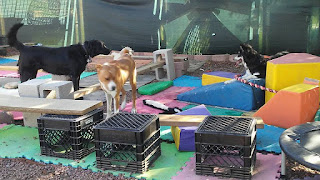

Before you commit to spending a $1000 or more and sending your dog away from home for 2 or 3 weeks, ask questions.  Find out exactly what is going to happen to your dog while in that training place.  Find out what happens to your dog when he does something right, what happens when he does something wrong, what tools will be used and the exact usage and fallout of those tools and an explanation of why that trainer uses those tools.  Find out also if you will receive instruction in what your dog learned and what maintenance you will have to do.  Done correctly, you should never have to do more than 5 minutes of maintenance training per day.

Be Aware, Be Prepared, Get Trained


Almost all behavior issues come from the home.  Most humans don’t understand dogs.  Especially those that profess that “all dogs love me”.  Dogs with behavior issues are either being misunderstood – i.e. normal dog behaviors are called problems because the human doesn’t like them, not because they are actual problems or abnormal behavior – or the humans are actively promoting abnormal behavior. They may not realize they are promoting this behavior, but it is true that aggression breeds aggression and a heavy hand produces fear in those that lack confidence.


So, if the humans don’t change, don’t learn, or refuse to accept that their dog is in fact a dog and not a furry human, all that money spent, all that time of learning will be for nothing. You cannot send your dog away to learn an entirely new set of rules and behaviors and then return them home to the exact environment and family behavior you started with and expect it to stick.


Training never ends.  Every moment of the day is training.  Learn how to maintain what your dog learned.


Sunday, February 9, 2020

Should you train your pet dog for service?


I receive many inquiries from people wondering if I can train their dog, who has been a pet dog, to be their service dog. I don’t blame these people for trying to minimize expenses in training and not having to accommodate another dog in the home. But not all dogs can make it as a service dog.

The first question you must always ask yourself is “Am I a candidate for a service dog?” The ADA (Americans With Disabilities Act) defines a service dog as a dog that is trained to do a task or work for a person with a disability.  It is important to remember that in the context of the ADA, “disability” is a legal term rather than a medical one. Because it has a legal definition, the ADA’s definition of disability is different from how disability is defined under some other laws, such as for Social Security Disability related benefits.


The ADA defines a person with a disability as a person who has a physical or mental impairment that substantially limits one or more major life activity. This includes people who have a record of such an impairment, even if they do not currently have a disability. It also includes individuals who do not have a disability but are regarded as having a disability. The ADA also makes it unlawful to discriminate against a person based on that person’s association with a person with a disability.

Some examples of disabilities are:

  • ·         vision Impairment.
  • ·         deaf or hard of hearing.
  • ·         mental health conditions.
  • ·         intellectual disability.
  • ·         acquired brain injury.
  • ·         autism spectrum disorder.
  • ·         physical disability affecting movement
  • ·         Impaired ability to breathe
  • ·         A disease that limits your life experience (diabetes, epilepsy, etc.)

The second question you need to ask, if you do actually have a disability, is, “how could a service dog help me to live more fully in the area my disability affects?”


A service dog is much more than just a dog who is highly trained in obedience.  By ADA law, a service dog is one who is trained to do a task or work for a person with a disability. That task or work must DIRECTLY relate to that person’s disability.  I know of no disability or disease where a dog doing a “sit” is helping that person.  And yet there are trainers out there, many of them, that will sell you a dog from 30 to 60 thousand dollars and the only training the dog has had is sit, down, come, heel, stay and maybe go to your mat.


There are also many owner trainers out there, mislead by others, who will wash their dog out of the training and start over with another dog, just because the dog doesn’t do a down in a grocery store but in the tasks the dog has been trained to do the dog is nearly 100% effective and reliable.  Where is a down necessary for a disability?  Unless it’s a trained alert to a medical condition, I don’t understand why someone would wash a perfectly good service dog.


So along with the question of “how could a service dog help me to live more fully in the area my disability affects?” you should include “what can I train the dog to do to help me with living more fully in the area my disability affects?”


Here is a story about one of my clients.  


M was 12 years old when she was diagnosed with a condition called Mast Cell Activation Syndrome.  Basically, her mast cells had decided that she was allergic to everything.  For the next 3 years, she lived in her sealed bedroom with three air purifiers trying to prevent a trip to the ER because her throat had completely closed up.


When she was 15, she found me and asked if I could train a dog to help her.  I did and since that time she has gotten her drivers license, bought a truck and has a job.  Her service dog watches her histamine levels and warns her when they start rising giving her time to take her rescue medications and avoid a trip to the ER.


That is what it means to have a service dog.  The dog helps you live more fully and is trained to assist you with those things you cannot do.  I don’t know of any human or any machine that could detect the minute rise in histamine levels in a human body with the accuracy of the dog I trained for M.

Last and final questions, and they basically have a lot to do with each other.


1.        Do you have the finances to pay a trainer or the time to do the training yourself? And if doing the training yourself, are you qualified or educated in dog enough to do so, or can you learn with the help of videos, books or a qualified trainer?


2.       Are you prepared to fully commit to 12 to 18 months of initial training and then a dog’s lifetime of maintenance training?  Even a highly trained service dog needs maintenance.  I dare anyone to suggest that what they learned in high school French is a fluent as it was in high school.  Don’t expect your dog to retain that training any more than you did.


3.       Do you have a home that can accommodate your service dog?  No other dogs, or if you do have other dogs, they have no behavior issues that your service dog might emulate because it’s allowed? A landlord that fits into the FHA rules for having to accommodate a service dog (not all have to comply)?  Family that will support you and learn along with you about your service dog?


If you can honestly answer all those questions in the affirmative, that it’s time to figure out if your existing dog can make the grade.

Is my dog a candidate for service dog work?


Here are some questions you should ask yourself about the dog you want to train.


Is my dog…

  • ·         Friendly but reserved with strange people?  Can he ignore them when working?
  • ·         Friendly or neutral towards other animals? Can he ignore them when working?
  • ·         Healthy and with good physical structure? Of a young enough age that the time or money expense and the years of service the dog could give are equitable?
  • ·         Comfortable around loud noises, traffic, and even minor distractions?
  • ·         Quiet, even when excited?
  • ·         Self-confident, self-controlled, doesn’t need major impulse control training, especially around food?


There are more questions of this type that should be looked at, but if your dog passes these questions, the main ones to consider are: how old is the dog?  How many years of service could this dog actually give me? How trainable is this dog? Is this dog of a size to do the job?


You wouldn’t want to consider a dog under 55 lbs. for mobility assistance, but a 10lb dog would be perfectly adequate doing medical alert as long as it didn’t involve waking you up.


Is my dog…


  • ·         Suspicious or wary of strangers preferring to advance to warn them off?
  • ·         Easily startled with novel experiences”
  • ·         Overly excited, reactive or frustrated around other dogs?
  • ·         Warning level to others generally higher than just a growl?  
  • ·         Fearful of new places, strange noises, people, or animals?


In most cases, a competent behaviorist could handle these issues.  There are no guarantees however, and the dog could revert at any time. My current service dog Chesovy is suspicious of most men due to an incident with a man breaking into our home. He has gotten better, but mostly I just keep him away from strangers.  No one needs to interact with a service dog anyway.  


Again, there are other things you should look at when considering your current pet dog as a service dog candidate.  In 90% of cases, the answer is no. Most people give their pet dogs too much leeway for unacceptable behavior and that is not always quickly handled with training.


Age of the dog is a big consideration.  In most cases of people asking me to train their current pet, that pet is too old or of a breed that has a short life span (Great Danes, Irish Wolfhounds), or a breed that has traits that preclude being able to fully focus on a human (scent or sight hounds).  If you are going to spend 12 to 18 months training your dog, you should be ready to expect at least 5 to 6 years of service before you have to start training another dog.  You should also be willing to start training a replacement before your current service dog is too old or too sick to work effectively.