At times I am straightforward to the point of bluntness - especially about the wrongs we are doing to our dogs in the name of training. In some circles, I’m already being criticized for what I have written about those methods and the mindset that carries the need to use harsh methods. I wish I could tell you that the unpleasantness doesn’t bother me a bit. I can’t. I am all too human. But, it won’t stop me. I owe dogs too much to be silent. We all do. Loving and appreciating dogs as I do, the concept of having to dominate them physically and emotionally breaks my heart. Dogs do not understand the “mind games” this methodology employs and can react in unpredictable ways to it's use. It also brings out the absolute worst in the humans who need to use it. I am committed to helping people understand a more enriching way to live and work with dogs.
I really think most anyone would benefit from learning about relationship building and play training. If you already understand about dog behavior, bonding with a dog, ways that dogs benefit humans--then a different training methodology will reinforce and support what you know, making that knowledge more sure. But, most people do not know these things. They and the dogs they have or deal with are paying high prices for what they don't know.
Dogs love to help. It gives their lives special meaning and makes them very happy. Help is not just trained behaviors. There are so many things dogs do for us that go beyond training. Happy, upbeat, positive training is important to do with any dog. Heck, you're training the dog one way or the other, because the dog is learning from every experience. It helps both the dog AND YOU to learn desirable behavior in positive ways.
There are at least as many methods of raising and training dogs as there are on raising and educating children, and undoubtedly as many points of view. There are scores of television shows and Internet sites professing to have the "secret" of success in teaching your dog what to do, and more importantly, what NOT to do.
Dogs have evolved and grown alongside mankind for thousands of years. Their wants and needs are parallel to our own - to be physically well, to be safe, to know friendship and love, and to be content in their lives. And as dogs help us find these things for ourselves, as friends we should help them do the same. If you can start with one simple premise it should be: treat "man's best friend" like a friend.
Much ado is made in current dog training of the "pack mentality" of the dog's wolf ancestors. The theory is that our dogs must be taught their place, with we their owners as the "alpha" canines. Most behaviorists know (and research supports) that dogs are NOW not wolves, and even if they were, a pack is not a group of unassociated animals fighting for dominance. A pack is a family unit; the alpha pair are the parents, and the pack works together to supply its needs. Think about it - a group of animals continually fighting each other for dominance would not survive for long in the wild. And they won't survive long in any home either.
Learn to understand your dog's behaviors from the dog's perspective. He just wants to be well, and safe, and loved, and happy. He simply lacks the vocal ability to tell us how that can happen. He acts out his worries and fears (like many of us humans do as well). We need to learn to read the signs, not browbeat our friends into silence. That doesn't mean we let our dogs run wild. Learn how to deal with problem behaviors, from chewing furniture to jumping up to biting. Dogs have spent millennium learning to get along with us; it is only fair to spend a few hours returning the favor and treating man's best friend as what he is.
The methods I now use are based on respect for dogs as sentient creatures with feelings, intelligence, and dignity and creatures with a special relationship, developed and honed over thousands of years, with humankind. I have been where the harsh trainers are - it was the way I was taught long before the Internet and 'dog training schools' ever existed.
I challenge all "new" and "old time" trainers to join me in using methods that celebrate the relationship between dogs and humans.
Wednesday, November 16, 2011
Sunday, November 13, 2011
The Walk
I, Micah, love going for a walk, exploring the wider world, sniffing around and checking out the crazy animals that cross my path. My sisters (Brynda and Storm) also love these walks. We, especially Brynda, also love to run along beside the tricycle just moving our bodies and feeling the wind. Most of the time we really enjoy getting out, but not when we see another dog being dragged along by it's human or having to pull and pull to get anywhere. Why do these dogs do this? Why do the humans do this? What went wrong?
As a puppy, I followed my human around all the time. She was really good at finding all the interesting smells and objects and always pointed them out to me, sometimes running and waving and showing me something truly interesting. She would even help me chase squirrels up trees and commune with the ducks in the pond at the park. She still does this almost three years later when we're walking. When we're running, we're just enjoying the thrill of moving fast and catching all the smells there are. We also spent a lot of time at the dog park where she would play with us, teach us new things to do with balls and rags and whip the rabbit around on the end of the pole for us to chase and grab. She was usually the most interesting and exciting thing around. She also protected us from some of the bullies who would come to the park and always let us know that if we had to defend ourselves because some dufus was attacking that it was ok, that we wouldn't be punished because something had to be done to save our skins.
So what happens with other dogs? Why do they not have the same relationship with their humans? What went wrong?
For us dogs, when we’re out and about, most of us understand that it’s in our best interest to be connected to our owners one way or another for our own safety. Sure there are times when something will catch our attention and we'll want to chase it - it's part of our nature to do so. It's a survival instinct. If it moves, it's fair game. Even the cat that lives in our house knows this game. She knows that if she just walks, we'll sniff and maybe invite her to play, but if she runs, we have to chase, our legs take off and we just have to follow !!
As dogs, we have four legs. Our humans only have two and move SOOOOOOOOOO slowly. Humans seem to be unaware of this fact or they are so self-absorbed that they choose to ignore it. Many talk about a dog's need for exercise and then require that we do something so boring, so mindless that frustration is the inevitable result. The humans require that we move at their pace, which is agonizing, and never deviate from the path to sniff or explore. Humans rarely chase anything, they have no clue how to sniff for information about who was there an hour ago or yesterday or even last week, and they constantly want to stop to bark at other humans totally ignoring us dogs.
Another thing I've noticed with some of these humans is that they have no clue how to greet each other. They just walk straight up to each other and touch paws or even grab each other like they were mounting. They seem to forget that they are holding our leashes and that perforce we must follow their lead and do what they do. It's so alien and uncomfortable to meet another dog, or even another human, without all the ritual that keeps things calm and focused. You are supposed to curve in toward the other dog, take your time gathering information with your nose, maybe even turn away a few times to show that you mean no harm. We're predators and yet you want us to act like prey. When you force us to move so quickly, facing the other in confrontation, you are also forcing us to give off more exacting signals to the other dog that things are tense but that we'd like to keep things calm. Then you punish us for those calming signals !
Do you humans not wonder why we tend to get defensive about meeting others this way? Do you not wonder why we eventually end up lunging and barking and even biting? We wonder how you can do what you do without having a brawl right there on the sidewalk. You teach us that we can't rely on our subtle communications, our need to take things slow and calm. You teach us that we also shouldn't be using our major signals with yelling, yanking, poking, kicking, shocking and pinching. So what do you expect us to do? We are social creatures, just as you are, but when you deprive us of what we were taught by our parents on how to greet others, there is only one thing left - make the other go away by any means possible so that conflict doesn't happen.
Which means the end of our walks :(
As a puppy, I followed my human around all the time. She was really good at finding all the interesting smells and objects and always pointed them out to me, sometimes running and waving and showing me something truly interesting. She would even help me chase squirrels up trees and commune with the ducks in the pond at the park. She still does this almost three years later when we're walking. When we're running, we're just enjoying the thrill of moving fast and catching all the smells there are. We also spent a lot of time at the dog park where she would play with us, teach us new things to do with balls and rags and whip the rabbit around on the end of the pole for us to chase and grab. She was usually the most interesting and exciting thing around. She also protected us from some of the bullies who would come to the park and always let us know that if we had to defend ourselves because some dufus was attacking that it was ok, that we wouldn't be punished because something had to be done to save our skins.
So what happens with other dogs? Why do they not have the same relationship with their humans? What went wrong?
For us dogs, when we’re out and about, most of us understand that it’s in our best interest to be connected to our owners one way or another for our own safety. Sure there are times when something will catch our attention and we'll want to chase it - it's part of our nature to do so. It's a survival instinct. If it moves, it's fair game. Even the cat that lives in our house knows this game. She knows that if she just walks, we'll sniff and maybe invite her to play, but if she runs, we have to chase, our legs take off and we just have to follow !!
As dogs, we have four legs. Our humans only have two and move SOOOOOOOOOO slowly. Humans seem to be unaware of this fact or they are so self-absorbed that they choose to ignore it. Many talk about a dog's need for exercise and then require that we do something so boring, so mindless that frustration is the inevitable result. The humans require that we move at their pace, which is agonizing, and never deviate from the path to sniff or explore. Humans rarely chase anything, they have no clue how to sniff for information about who was there an hour ago or yesterday or even last week, and they constantly want to stop to bark at other humans totally ignoring us dogs.
Another thing I've noticed with some of these humans is that they have no clue how to greet each other. They just walk straight up to each other and touch paws or even grab each other like they were mounting. They seem to forget that they are holding our leashes and that perforce we must follow their lead and do what they do. It's so alien and uncomfortable to meet another dog, or even another human, without all the ritual that keeps things calm and focused. You are supposed to curve in toward the other dog, take your time gathering information with your nose, maybe even turn away a few times to show that you mean no harm. We're predators and yet you want us to act like prey. When you force us to move so quickly, facing the other in confrontation, you are also forcing us to give off more exacting signals to the other dog that things are tense but that we'd like to keep things calm. Then you punish us for those calming signals !
Do you humans not wonder why we tend to get defensive about meeting others this way? Do you not wonder why we eventually end up lunging and barking and even biting? We wonder how you can do what you do without having a brawl right there on the sidewalk. You teach us that we can't rely on our subtle communications, our need to take things slow and calm. You teach us that we also shouldn't be using our major signals with yelling, yanking, poking, kicking, shocking and pinching. So what do you expect us to do? We are social creatures, just as you are, but when you deprive us of what we were taught by our parents on how to greet others, there is only one thing left - make the other go away by any means possible so that conflict doesn't happen.
Which means the end of our walks :(
From a dog's viewpoint.
You adopted me and brought me to a strange place. It doesn't matter how old I am, how much life experience I've had, there are going to be times when I've just had enough of the strangeness. As a dog, I communicate mostly by moving parts of my body in ways that let others know how I'm feeling. It's all in the emotion, the energy that builds up because of stress and then comes out as motion. Even when I seem to be frozen in place, there are still those signs that show my discomfort, uncertainty or fear.
I can tell you in many ways that dealing with life has become a little difficult. I might yawn more than normal or turn my head away and ignore your behavior or the behavior of the other dogs around. Do you notice these signs? Have you learned what these signals mean? I can scratch when I don't itch, lick my paws, my eyes can get red and show the whites. Are these signs too subtle for you to notice, or perhaps you notice them but choose to ignore them because you don't understand?
When you don't notice or choose to ignore what I'm saying to you, there are other, more overt things I can do. When you come home, and really it doesn't matter how long you were out of my sight, I can jump on you, nip your hands, legs, or face. I can do all that when anything exciting happens just to let you know that it's hard for me to handle the excitement. I could mount everything in sight just to release the pressure of the stress. I heard that some people think my mounting behavior is due to "dominance" or trying to take control, but it's mostly a sign of stress and too much excitement. It's so comforting to mount cushions and your legs when my excitement or frustration levels are brimming over and I just can't cope. I can do the same with the other dogs when they are playing and I just need them to not be so exciting. I guess you could say it's "dominance" or the need to control, but what I'm really trying to say is that it's just too much !
If you are still ignoring my communications, I can ratchet it up another notch. All that nasty stressful, anxious energy could become restless pacing around the house, not being able to settle anywhere, not even with 2 hours of running or the treadmill that you may be told is what I need. I could start stealing your things, especially things that smell like you or just smell good. Getting into the garbage is a great way to take my mind off the stress. I could even start peeing in the house to relieve the pressure. It just feels so good to have something go out of my body when everything seems to be crowding in. But I've heard that you could be told this is a dominant act also.
So how do I get your attention? How do I communicate to you that life is too hard for me right now? Humans talk, they seem to talk a lot, so I could do that too! I could start barking at everything. This is bound to get your attention, but is it really the kind of attention that I want? What are you going to do when I bark all the time, at you, at the kids, at other dogs, at your guests, at a leaf blowing around the yard. What you don't seem to understand is that it helps to relieve all the pressure inside me. So when you bring out the bark collars, when you try to suppress my loud communication, what you're really doing is causing all the stress energy to remain inside me, building up even more pressure and eventually I will explode.
After all that, when you've ignored me or told me with blows and pinches and shocks and bad smells that I can't do all those things to communicate my stress to you, what is left? I have a choice here, I can do something or I can withdraw and wallow in my misery. I could start ignoring your communications - not do all those obedience things you taught me and just stare at you like you're crazy. I could turn into a tazmanian devil and growl and bark and lunge and snap at everyone - human or canine. I could even attempt to kill the cat.
All of these things are just my attempt to communicate with you, to tell you that things are not good for me, that I'm missing something in my life or that life right now is just too much and I can't handle it. Why would you punish me for this?
I can tell you in many ways that dealing with life has become a little difficult. I might yawn more than normal or turn my head away and ignore your behavior or the behavior of the other dogs around. Do you notice these signs? Have you learned what these signals mean? I can scratch when I don't itch, lick my paws, my eyes can get red and show the whites. Are these signs too subtle for you to notice, or perhaps you notice them but choose to ignore them because you don't understand?
When you don't notice or choose to ignore what I'm saying to you, there are other, more overt things I can do. When you come home, and really it doesn't matter how long you were out of my sight, I can jump on you, nip your hands, legs, or face. I can do all that when anything exciting happens just to let you know that it's hard for me to handle the excitement. I could mount everything in sight just to release the pressure of the stress. I heard that some people think my mounting behavior is due to "dominance" or trying to take control, but it's mostly a sign of stress and too much excitement. It's so comforting to mount cushions and your legs when my excitement or frustration levels are brimming over and I just can't cope. I can do the same with the other dogs when they are playing and I just need them to not be so exciting. I guess you could say it's "dominance" or the need to control, but what I'm really trying to say is that it's just too much !
If you are still ignoring my communications, I can ratchet it up another notch. All that nasty stressful, anxious energy could become restless pacing around the house, not being able to settle anywhere, not even with 2 hours of running or the treadmill that you may be told is what I need. I could start stealing your things, especially things that smell like you or just smell good. Getting into the garbage is a great way to take my mind off the stress. I could even start peeing in the house to relieve the pressure. It just feels so good to have something go out of my body when everything seems to be crowding in. But I've heard that you could be told this is a dominant act also.
So how do I get your attention? How do I communicate to you that life is too hard for me right now? Humans talk, they seem to talk a lot, so I could do that too! I could start barking at everything. This is bound to get your attention, but is it really the kind of attention that I want? What are you going to do when I bark all the time, at you, at the kids, at other dogs, at your guests, at a leaf blowing around the yard. What you don't seem to understand is that it helps to relieve all the pressure inside me. So when you bring out the bark collars, when you try to suppress my loud communication, what you're really doing is causing all the stress energy to remain inside me, building up even more pressure and eventually I will explode.
After all that, when you've ignored me or told me with blows and pinches and shocks and bad smells that I can't do all those things to communicate my stress to you, what is left? I have a choice here, I can do something or I can withdraw and wallow in my misery. I could start ignoring your communications - not do all those obedience things you taught me and just stare at you like you're crazy. I could turn into a tazmanian devil and growl and bark and lunge and snap at everyone - human or canine. I could even attempt to kill the cat.
All of these things are just my attempt to communicate with you, to tell you that things are not good for me, that I'm missing something in my life or that life right now is just too much and I can't handle it. Why would you punish me for this?
Sunday, November 6, 2011
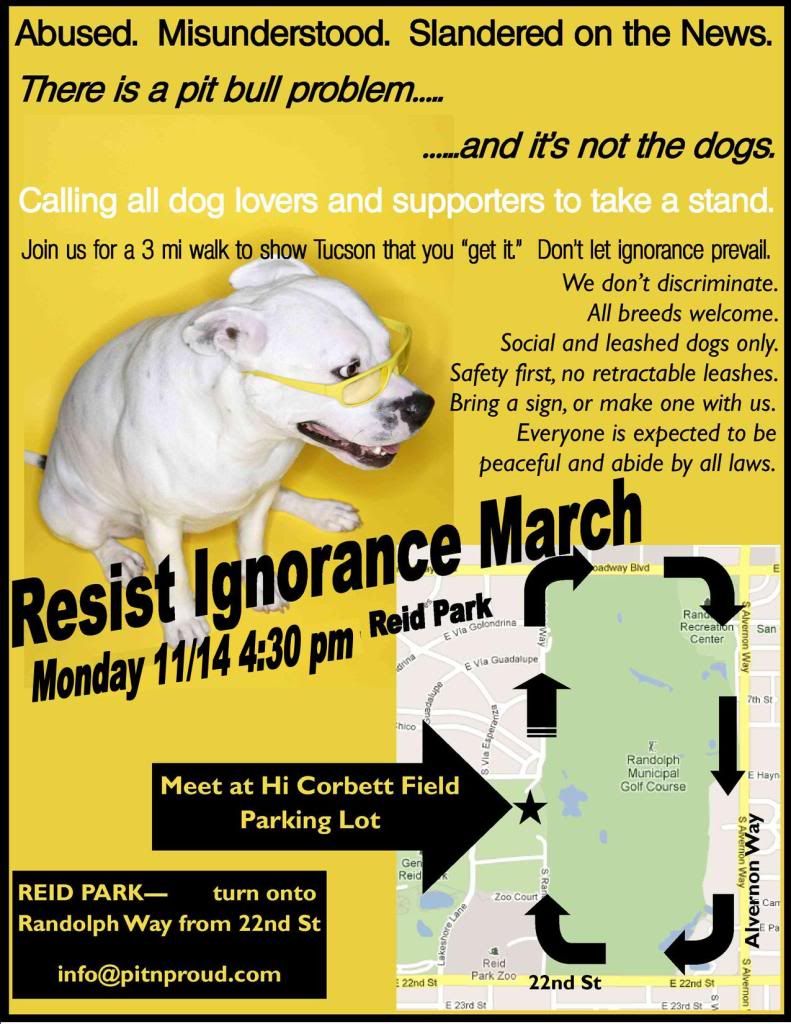
Resist Ignorance March
Join Tucson area dog lovers as we walk for pit bulls! In light of the recent biased and slanderous media coverage, we urge you to join us and show the Tucson community that we will not tolerate ignorance. Judging dogs by breed is akin to racism. If you don't own a bully breed, understand that it could be your breed next. Dogs are products of their environment, socialization, and training. Good owners make good dogs. We demand that the media focus on the real circumstances of bites and attacks, and cease their vilification of dogs based on breed alone.
We will meet in the Hi Corbett Field parking lot. Turn North on Randolph Way from 22nd. We will begin walking at 4. Bring a sign, or come early and make one with us.
All breeds of dogs welcome. You don't have to have a dog to walk. Dogs must be leashed and social. One dog per handler. No retractable leads and no nose-to-nose contact between dogs. All attendees are expected to be civil, and abide by all laws.
We will be taking a stand, but this will be a light-hearted and positive event, and a great opportunity to connect with other bully lovers.
Join Tucson area dog lovers as we walk for pit bulls! In light of the recent biased and slanderous media coverage, we urge you to join us and show the Tucson community that we will not tolerate ignorance. Judging dogs by breed is akin to racism. If you don't own a bully breed, understand that it could be your breed next. Dogs are products of their environment, socialization, and training. Good owners make good dogs. We demand that the media focus on the real circumstances of bites and attacks, and cease their vilification of dogs based on breed alone.
We will meet in the Hi Corbett Field parking lot. Turn North on Randolph Way from 22nd. We will begin walking at 4. Bring a sign, or come early and make one with us.
All breeds of dogs welcome. You don't have to have a dog to walk. Dogs must be leashed and social. One dog per handler. No retractable leads and no nose-to-nose contact between dogs. All attendees are expected to be civil, and abide by all laws.
We will be taking a stand, but this will be a light-hearted and positive event, and a great opportunity to connect with other bully lovers.
How we take a dog from reactive to social.
Storm and I went to the Arizona Greyhound Rescue Fall Festival yesterday. We had a booth and we did a demo. Here is the video of the demo - How we take a dog from reactive to social.
Thursday, November 3, 2011
Perception - Part III
Here are a few tidbits from a thread on Facebook from another trainer who specializes in Pit Bulls, is a major contributor to the Pit Bull support forum and just an all around great lady !!
Hello stupid people, when you get a pit bull puppy from a sketchy situation and call me for advice, please don't ignore that advice. When I suggest heavy socialization, offer puppy kindergarten, and impress upon you why proper obedience is a must, do you even realize how much it angers me AND rips my guts out when you do none of that yet call me a year later to dump that dog because he's now "aggressive"?? Ugh.
And all the Comments...
If you dont know or dont understand the breed ,,, learn or dont have one,, Its not the puppies fault its yours.... Stupid owners..
Train your dogs, SOCIALIZE your dogs, don't breed indiscriminately. The only real way to get rid of the public and media perception of pit bulls is to give them no fodder for their propaganda mills. Don't give them incidents they can sensationalize and make $$$ off of.
Hello stupid people, when you get a pit bull puppy from a sketchy situation and call me for advice, please don't ignore that advice. When I suggest heavy socialization, offer puppy kindergarten, and impress upon you why proper obedience is a must, do you even realize how much it angers me AND rips my guts out when you do none of that yet call me a year later to dump that dog because he's now "aggressive"?? Ugh.
And all the Comments...
there are a million of those people getting these dogs, and they are the route of our problem. training and rehab is a must if we are going to continue to rescue the breed we so adore and love♥
People need to be educated when it comes to pitbulls...they aren't bad dogs but when they come from bad situations, it takes a person with experience, patience, and a lot of love to give to take them in and teach them to trust again and how to be embassadors for the breed...I know I own one...God bless you for what you do
Its so sad that people like this ruin our breed....it's not the breeds fault its the people. Thanks for helping try to educate them.....its all we can do
I would tear someone a new asshole for that shit. What a waste and a ruined dog. Depending on the level of aggression, it can be a real hassle to teach the dog to ignore another animal. It's manageable, but a pain in the ass. I have some like that, but I got them as adults. I work with them the best I can. The dog may have already been more prone to animal aggression when those people got him, but damn....work with you dogs, people. We're trying to get the breed OUT of a bad spot light, not keep them in it. Jenn, at least you tried and sometimes that's all we can do. Pick up the pieces later.
Train your dogs, SOCIALIZE your dogs, don't breed indiscriminately. The only real way to get rid of the public and media perception of pit bulls is to give them no fodder for their propaganda mills. Don't give them incidents they can sensationalize and make $$$ off of.
Wednesday, October 26, 2011
Perception - Part II
Why is that humans have a tendency to react all out of proportion when they think they have been criticized? I'm not talking about real criticism, just the perception of it. What causes such a vicious reaction to a simple statement that the impression you give off is critical when trying to change perception.
Could it be that the person who is reacting, deep down actually realizes that what they are doing is exactly what was said? That the methods they use, the public display of those methods and the way they dress and act will affect what others think? That the world doesn't revolve around them? Do they actually feel some guilt and they just can't admit it because being wrong would mean death? Or are they more interested in insisting on their own rightnesses than they are in finding truth?
Being right or being wrong is also perception. There is no "right" or "wrong", there is only agreement on what is right or wrong and even that agreement has rules to it - such as: that you can do a wrong if the justification is good enough or will save a life.
Most people, in my experience, have a need to be "right" irregardless of reality (and again, reality is only agreements on what really is real). I even had a relative tell me one time that the encyclopedia was wrong and that he was right. Why do they HAVE to be RIGHT? Because being wrong means they are one step closer to being invisible in their own minds. Being wrong is a threat to their ego, their beingness and in some cases - their life.
People will actually change reality, in their own minds, to fit their need to be right. These types of people are more interested in asserting their own rightness than in being right. These people will actually repeat the wrong action just to prove they are right. Close to the definition of insanity - repeating something that doesn't work hoping that one day it will actually work.
Why, if a person IS right, would they object so vehemently to what they DO being displayed in an article?
Link to the first post
Could it be that the person who is reacting, deep down actually realizes that what they are doing is exactly what was said? That the methods they use, the public display of those methods and the way they dress and act will affect what others think? That the world doesn't revolve around them? Do they actually feel some guilt and they just can't admit it because being wrong would mean death? Or are they more interested in insisting on their own rightnesses than they are in finding truth?
Being right or being wrong is also perception. There is no "right" or "wrong", there is only agreement on what is right or wrong and even that agreement has rules to it - such as: that you can do a wrong if the justification is good enough or will save a life.
Most people, in my experience, have a need to be "right" irregardless of reality (and again, reality is only agreements on what really is real). I even had a relative tell me one time that the encyclopedia was wrong and that he was right. Why do they HAVE to be RIGHT? Because being wrong means they are one step closer to being invisible in their own minds. Being wrong is a threat to their ego, their beingness and in some cases - their life.
People will actually change reality, in their own minds, to fit their need to be right. These types of people are more interested in asserting their own rightness than in being right. These people will actually repeat the wrong action just to prove they are right. Close to the definition of insanity - repeating something that doesn't work hoping that one day it will actually work.
Why, if a person IS right, would they object so vehemently to what they DO being displayed in an article?
Link to the first post
Monday, October 24, 2011
Perception
It really does matter what other people think. What other people think changes laws, creates common cultural responses, affects how you dress, how you eat, how you drive your car.
Pit Bulls are banned, attacked and vilified now, but that hasn't always been the case. Rottweilers, German Shepards and Dobermans in past decades have shared this spotlight. It seems to be part of human nature to need villains and monsters.
The current common perception of pit bulls is enhanced by many of the same people who say they are trying to change that perception.
Commonly associated with pit bulls are gangs, drugs and of course dog fighting. If you walk the streets of most inner cities, you'll see pit bulls sporting collars with two inch spikes and heavy chains instead of collars. The perception is that either 1) in the case of the spikes on the collar that the dog is dangerous and made even more so by the spikes or 2) in the case of the heavy chain and thick ropes, that the dog needs extreme measures to control it.
Yesterday I attended an event that was designed to create a good impression of pit bulls. In many ways it did just that. But in others, not only was the message lost, but the current perception was upheld.
For instance, there were five demo's yesterday. Two demos did not involve pit bulls. One from the Border Patrol with German Shepards, one from the Doberman rescue. Both demo's showed these two breeds in a good light. The Shepards showed off their search and rescue and their scenting abilities in finding drugs and even people. The Doberman demo showed how to control the prey drive of the dog with fun games, played by rules and how to positively interact with the breed.
The third demo was of pit bulls attacking ropes hanging from chains and holding on so tight and so long they appeared to have the mythical lock jaw that is actually physically impossible. I'm all for exercising a dog, especially a powerful dog, but every time I saw one of the dogs attack those ropes all I could picture is what would happen if that dog went for a throat.
This same group did show pit bulls in a good light doing the weight pull competition. This is an activity where pits shine and should be promoted - not (IMO) attacking something, not in public where you are trying to create a good impression, not even something as inanimate as a ball on a string when it could so easily be misconstrued.
The fourth demo was my own. The drill team. We didn't perform all that well, it was hot, the dogs didn't want to work, especially my own dog and we weren't as coordinated as we should have been. But what the dogs were doing and how we worked with the dogs, showed a totally positive light on what the breed can be like and how positive training works even on a powerful breed of dog. During the course of our demo, the dogs showed off 10 behaviors / tricks that they had learned in the last 3 months. The kind of behaviors and tricks that most people teach their dogs, no matter what breed. Sit, down, stay, come, beg, crawl, circle, go around, back up and our specialty of hug the flag - all on a loose leash with no corrections, no punishment, no shocks.
The fifth demo could have been just as positive, but (again In My Opinion) failed. It was an obedience demo and whereas the dog did marvelous, his owner trainer had been walking around the event with a client dog for a couple of hours before his demonstration.
This client dog was sporting an e-collar. The remote was in the trainers hand and he was actively shocking the dog at intervals. I never did figure out what the dog had attempted to do that the trainer didn't like that elicited a shock, but one time, right in front of the main event tables where the DJ was, the dog was shocked at least 7 times (and corrected also with the choke collar getting jerked) in the space of 2 minutes and made to crawl and grovel on the ground from the shock.
How is this going to change the perceptions that people have a bout those "dangerous" pit bulls? This post is not about shock collars, corrective type training or even that particular trainer. This post is about the perception that is created in the minds of the public when they see the "experts" treat these magnificent dogs with disrespect, abuse and such tight control that a dog is forced to grovel on the ground in pain. Or asked to publicly attack and hold on for minutes to a rope that is at the same height off the ground as some one's throat?
I have to admit that I am a crossover trainer. I have to admit that not so very long ago, the shock collar would not have bothered me as it does today. But even back there, in this instance, the use of it would have bothered me as it does now, because I could not figure out why the dog was getting so viciously shocked. But even when I was using corrective measures, positive punishment and training my clients to use the same - I never did it in public. I never did it where others could misunderstand what was occurring or get a bad impression of the dog, the breed of dog (needing such harsh treatment to gain control) or myself as a trainer. And only twice have I ever used a shock collar in my life.
When I started my Reactive Dog group classes almost three years ago, I realized I had to find a better way then what I'd been doing up to that point. I immediately stopped teaching corrections. Not only was it counter productive in a group situation, but I felt that the skill necessary, the timing necessary for proper, effective corrections, could not be achieved in that environment.
What replaced positive punishment was focus, engagement, play and creating in the mind of the human that not only were they responsible for their dogs behavior but that they could change it easily. Every class since then has been fun, educational and effective. Yes, there have been those who drop out - mostly because they wanted the magic wand technique and didn't want to expend the effort needed to help their dog achieve success. The times when I slipped back and jerked a collar, alpha rolled a dog or tried to teach someone to do the same, ended up in chaos and I lost some of the respect I'd built in that group.
So yes, what others think really does matter. What you project will create what others think. Be aware of what perception you are creating. Do your actions and the response they create with your dog create respect, admiration, hope and affinity in those watching? Or are you promoting that which you say you are trying to eradicate?
Pit Bulls are banned, attacked and vilified now, but that hasn't always been the case. Rottweilers, German Shepards and Dobermans in past decades have shared this spotlight. It seems to be part of human nature to need villains and monsters.
The current common perception of pit bulls is enhanced by many of the same people who say they are trying to change that perception.
Commonly associated with pit bulls are gangs, drugs and of course dog fighting. If you walk the streets of most inner cities, you'll see pit bulls sporting collars with two inch spikes and heavy chains instead of collars. The perception is that either 1) in the case of the spikes on the collar that the dog is dangerous and made even more so by the spikes or 2) in the case of the heavy chain and thick ropes, that the dog needs extreme measures to control it.
Yesterday I attended an event that was designed to create a good impression of pit bulls. In many ways it did just that. But in others, not only was the message lost, but the current perception was upheld.
For instance, there were five demo's yesterday. Two demos did not involve pit bulls. One from the Border Patrol with German Shepards, one from the Doberman rescue. Both demo's showed these two breeds in a good light. The Shepards showed off their search and rescue and their scenting abilities in finding drugs and even people. The Doberman demo showed how to control the prey drive of the dog with fun games, played by rules and how to positively interact with the breed.
The third demo was of pit bulls attacking ropes hanging from chains and holding on so tight and so long they appeared to have the mythical lock jaw that is actually physically impossible. I'm all for exercising a dog, especially a powerful dog, but every time I saw one of the dogs attack those ropes all I could picture is what would happen if that dog went for a throat.
This same group did show pit bulls in a good light doing the weight pull competition. This is an activity where pits shine and should be promoted - not (IMO) attacking something, not in public where you are trying to create a good impression, not even something as inanimate as a ball on a string when it could so easily be misconstrued.
The fourth demo was my own. The drill team. We didn't perform all that well, it was hot, the dogs didn't want to work, especially my own dog and we weren't as coordinated as we should have been. But what the dogs were doing and how we worked with the dogs, showed a totally positive light on what the breed can be like and how positive training works even on a powerful breed of dog. During the course of our demo, the dogs showed off 10 behaviors / tricks that they had learned in the last 3 months. The kind of behaviors and tricks that most people teach their dogs, no matter what breed. Sit, down, stay, come, beg, crawl, circle, go around, back up and our specialty of hug the flag - all on a loose leash with no corrections, no punishment, no shocks.
The fifth demo could have been just as positive, but (again In My Opinion) failed. It was an obedience demo and whereas the dog did marvelous, his owner trainer had been walking around the event with a client dog for a couple of hours before his demonstration.
This client dog was sporting an e-collar. The remote was in the trainers hand and he was actively shocking the dog at intervals. I never did figure out what the dog had attempted to do that the trainer didn't like that elicited a shock, but one time, right in front of the main event tables where the DJ was, the dog was shocked at least 7 times (and corrected also with the choke collar getting jerked) in the space of 2 minutes and made to crawl and grovel on the ground from the shock.
How is this going to change the perceptions that people have a bout those "dangerous" pit bulls? This post is not about shock collars, corrective type training or even that particular trainer. This post is about the perception that is created in the minds of the public when they see the "experts" treat these magnificent dogs with disrespect, abuse and such tight control that a dog is forced to grovel on the ground in pain. Or asked to publicly attack and hold on for minutes to a rope that is at the same height off the ground as some one's throat?
I have to admit that I am a crossover trainer. I have to admit that not so very long ago, the shock collar would not have bothered me as it does today. But even back there, in this instance, the use of it would have bothered me as it does now, because I could not figure out why the dog was getting so viciously shocked. But even when I was using corrective measures, positive punishment and training my clients to use the same - I never did it in public. I never did it where others could misunderstand what was occurring or get a bad impression of the dog, the breed of dog (needing such harsh treatment to gain control) or myself as a trainer. And only twice have I ever used a shock collar in my life.
When I started my Reactive Dog group classes almost three years ago, I realized I had to find a better way then what I'd been doing up to that point. I immediately stopped teaching corrections. Not only was it counter productive in a group situation, but I felt that the skill necessary, the timing necessary for proper, effective corrections, could not be achieved in that environment.
What replaced positive punishment was focus, engagement, play and creating in the mind of the human that not only were they responsible for their dogs behavior but that they could change it easily. Every class since then has been fun, educational and effective. Yes, there have been those who drop out - mostly because they wanted the magic wand technique and didn't want to expend the effort needed to help their dog achieve success. The times when I slipped back and jerked a collar, alpha rolled a dog or tried to teach someone to do the same, ended up in chaos and I lost some of the respect I'd built in that group.
So yes, what others think really does matter. What you project will create what others think. Be aware of what perception you are creating. Do your actions and the response they create with your dog create respect, admiration, hope and affinity in those watching? Or are you promoting that which you say you are trying to eradicate?
Sunday, October 23, 2011
Saturday, October 22, 2011
Harvey & Beau
Here is Beau. Beau is a pit mix up for adoption through Tucson Cold Wet Noses. Beau is also looking for a new foster hoem, he is currently in a kennel and is not doing well there. Many people have stepped up to help Beau have a bit of a life, but he really needs a home to learn how to live in the human world again.
Here he is playing with one of the dogs of one of the wonderful people who have been helping him .
Subscribe to:
Posts (Atom)